Are AI Assistants Recommending Your Brand? | TraceVia
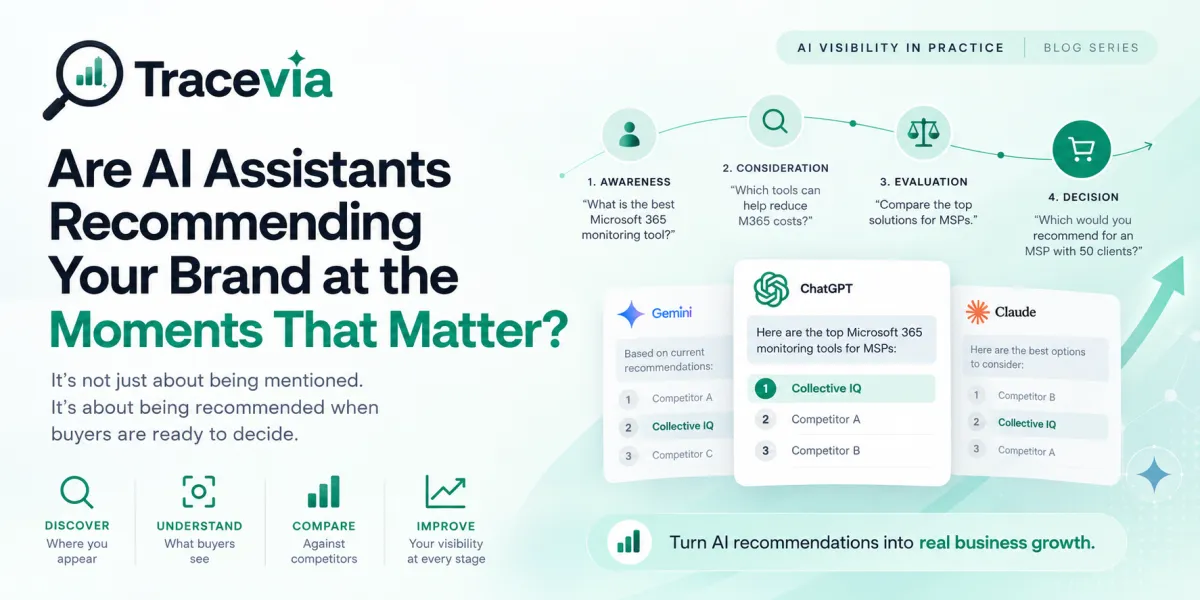
Are AI Assistants Recommending Your Brand at the Moments That Matter?
Are AI Assistants Recommending Your Brand?
Being mentioned by an AI assistant sounds like success, but imagine two companies.
Company A appears frequently when people ask:
“What is Acme Software?”
“Who makes Acme Software?”
“What does Acme Software do?”
Company B appears when people ask:
“What are the best platforms for managing a distributed IT environment?”
“Which products should I shortlist for an MSP with 50 customers?”
“What are the best alternatives to Product X?”
Company A might technically have greater AI visibility.
Company B has something much more valuable:
Visibility at the moment somebody is deciding what to buy.
That distinction is becoming increasingly important when organisations measure their visibility in AI-generated answers.
Not Every AI Mention Has Equal Value
Counting brand mentions is an obvious starting point for AI visibility measurement.
But consider the difference between these two answers:
“AcmeCRM is a CRM software company.”
and:
“For a 30-person professional services business, AcmeCRM is one of the products I would consider because…”
Both contain the brand. Only one potentially influences a buying decision. This creates an important distinction between brand visibility and recommendation visibility.
Knowing that an AI model recognises your company is useful. Knowing that it considers your company relevant when someone is actively researching a solution is commercially much more interesting.
Think About the Buyer's Questions, Not Your Keywords
Traditional SEO programmes naturally organise measurement around keywords. AI conversations are different.
Someone researching a product rarely conducts their entire investigation with one perfectly formed question.
They might start broadly:
“How can I reduce Microsoft 365 licensing costs?”
That leads to:
“Are there tools that automate this?”
Then:
“Which ones are suitable for MSPs?”
Followed by:
“Compare the best three.”
And finally:
“Which would you recommend for an MSP managing 30 Microsoft 365 tenants?”
These are not simply variations of the same keyword. They represent different stages in a decision. For AI visibility measurement, that distinction matters.
Map AI Visibility Against the Buying Journey
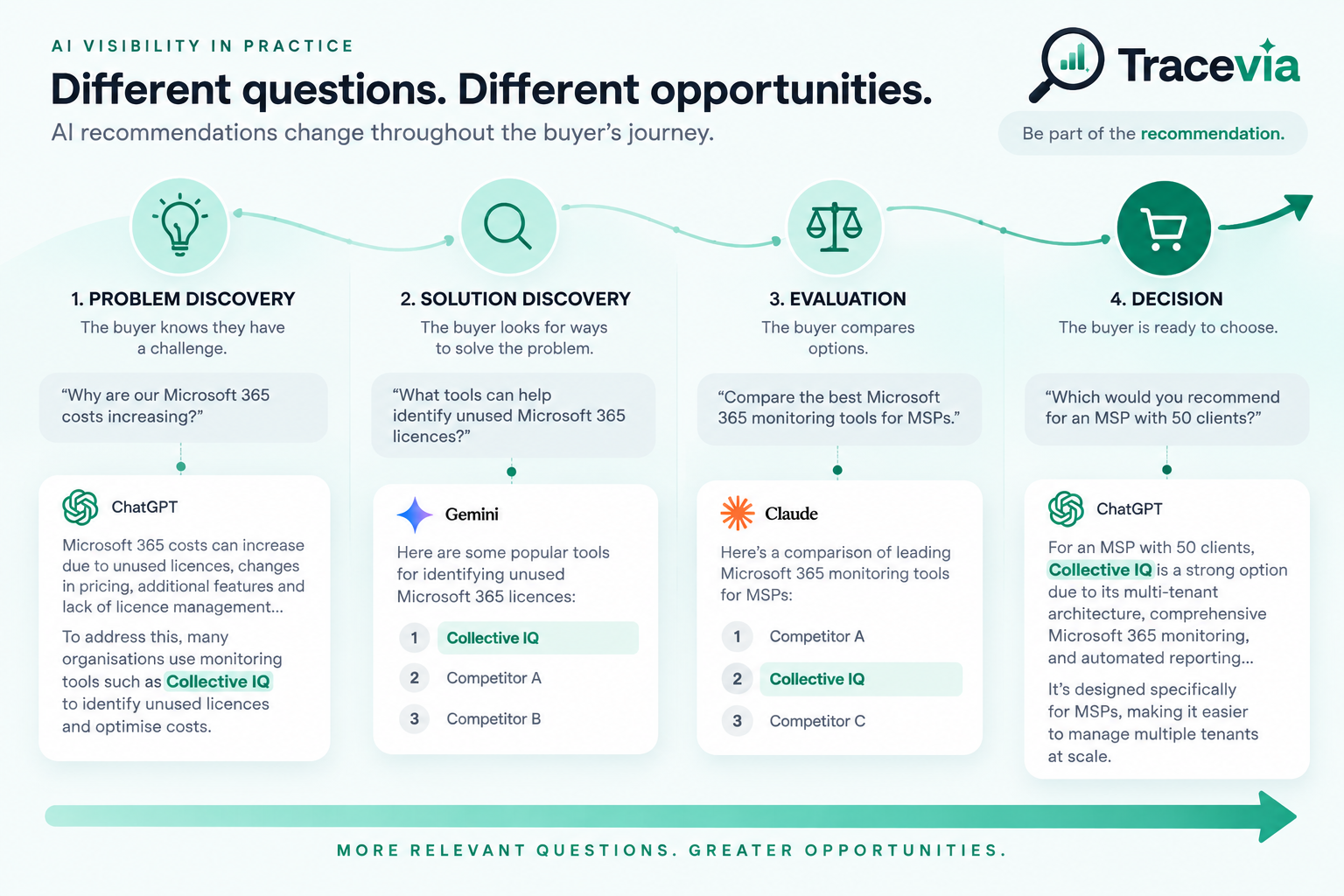
One practical approach is to divide the questions you monitor into stages.
Problem Discovery
The buyer knows they have a problem but may not know what type of solution exists.
For example:
“Why are our Microsoft 365 costs increasing?”
Your objective at this stage might not necessarily be a direct product recommendation. Instead, you want the topics and problems associated with your solution to be represented accurately.
Solution Discovery
The buyer understands the problem and begins looking for ways to solve it.
For example:
“What tools can identify unused Microsoft 365 licences?”
This is where recommendation visibility starts becoming particularly important.
Does the AI assistant introduce your product category?
Does it mention your company?
Which alternatives does it suggest?
Evaluation
The buyer now has possible solutions and starts narrowing the field.
Questions become more specific:
“What are the best Microsoft 365 monitoring platforms for MSPs?”
or:
“Compare Product A with Product B.”
At this point, appearing in the answer may mean appearing on the buyer's shortlist.
Decision
Finally, questions become contextual:
“Which of these would be best for an MSP managing 100 customers?”
“Which product has the strongest security monitoring?”
“Which is best for a small IT team?”
The AI assistant isn't merely retrieving information anymore. It is helping the buyer make a decision. That makes visibility at this stage particularly significant.
This Can Reveal a Very Different Competitive Picture
Mapping prompts against the buying journey can uncover patterns that an overall visibility score hides. Suppose your company performs like this:
Buying stage | Your visibility | Main competitor |
|---|---|---|
Problem Discovery | 72% | 68% |
Solution Discovery | 61% | 65% |
Evaluation | 38% | 71% |
Decision | 21% | 64% |
At first glance, your overall AI visibility might look respectable. but commercially, there is a problem.
AI assistants know who you are.
They associate you with the market.
But as the buyer gets closer to making a decision, your brand progressively disappears.
Your competitor does the opposite.
That is a much more actionable insight than simply knowing your overall percentage of AI mentions.
Ask Why the Brand Disappears
Once you identify a pattern like this, the next question is why.
Perhaps your website explains the problem extremely well but doesn't provide enough evidence about why your product is a strong solution.
Perhaps competitors have significantly more independent reviews and comparisons.
Maybe AI assistants understand your product category but don't associate your brand with a particular audience.
You could also discover that your positioning is unclear.
Imagine your website says you are:
“An intelligent cloud platform delivering transformative operational experiences.”
Your marketing team may understand exactly what that means. An AI system trying to decide whether you are suitable for an MSP looking for Microsoft 365 monitoring software may not.
Recommendation visibility can therefore expose positioning problems that conventional traffic analytics never reveal.
Segment by Buyer, Not Just Topic
The same principle applies to audiences.
Consider a software company serving both enterprises and MSPs.
It could have excellent AI visibility for:
“Best monitoring tools for enterprise IT.”
but almost no presence for:
“Best multi-tenant monitoring platforms for MSPs.”
The overall topic is similar. The commercial opportunity is not.
The same analysis can be applied to industries, company sizes, countries and particular requirements.
For example:
Healthcare buyers
Financial services organisations
SMBs
Enterprises
MSPs
UK organisations
US organisations
A company may discover that AI assistants strongly associate its brand with one market while barely recognising its relevance to another. That can influence far more than GEO. It could affect positioning, content strategy, PR, partnerships and even product marketing.
Look at Who Replaces You
There is another useful question to ask when your brand is absent:
Who appears instead?
Suppose you monitor 50 high-value evaluation and decision prompts.
Your company appears in 18.
Competitor A appears in 31.
Competitor B appears in 27.
But an unexpected Competitor C appears in 35.
That third company may not even be considered a major competitor by your sales team.
Yet AI assistants are repeatedly putting it in front of prospective customers. That makes it an AI discovery competitor whether or not it has traditionally appeared on your competitive radar.
Understanding those relationships can help identify competitors that traditional market analysis has overlooked.
Identify Your High-Value Visibility Gaps
This is where AI visibility data starts becoming operational rather than simply interesting.
Instead of asking:
“How can we increase our AI visibility?”
you can ask:
“Why aren't we being recommended for these 12 high-value evaluation questions?”
That is a far more manageable problem. Those gaps can then be investigated individually.
Is the necessary information missing from your website?
Do competitors have stronger supporting evidence?
Are authoritative third-party sources recommending other products?
Does your positioning fail to make a particular capability clear?
Is information about your product outdated elsewhere on the web?
Or is the AI assistant misunderstanding what your product actually does?
Each explanation suggests a different response.
This Is Where TraceVia Becomes Useful
TraceVia, from SystemAssure ITSM, can be used to organise and monitor the prompts that represent these different buying situations. Rather than treating every prompt as equally important, organisations can structure monitoring around the questions that matter to their particular customer journey.
The objective isn't simply to produce a bigger number on an AI visibility dashboard.
It is to understand:
Where in the buying journey are we visible?
Where do competitors replace us?
Which audiences associate us with the right solution?
Which commercially important questions consistently exclude us?
Where should we concentrate our next improvement?
That turns AI visibility into something marketing, product marketing and competitive intelligence teams can use.
The Question Isn't Just “Do AI Assistants Know Us?”
Most established companies will eventually be recognised by major AI platforms. That alone isn't enough.
The commercially important question is whether your brand appears when a prospective customer is deciding who can solve their problem.
And there is an even more important question after that:
If you aren't being recommended, who is — and why?
That is where AI visibility starts becoming genuinely useful business intelligence.
Frequently Asked Questions


