

What Is GEO? A Guide to Generative Engine Optimisation
What Is GEO (Generative Engine Optimisation) and Why Does It Matter?
What Is GEO? A Guide to Generative Engine Optimisation
For more than two decades, businesses have competed for visibility in search engines.
If somebody wanted a product, supplier or answer to a question, they searched Google or Bing. Businesses invested heavily in Search Engine Optimisation (SEO) to make sure their websites appeared when those searches happened.
That behaviour is beginning to change.
People are increasingly asking AI assistants such as ChatGPT, Gemini, Claude and Perplexity questions that would previously have started with a search engine.
Instead of searching:
Microsoft 365 monitoring software
someone might ask:
"What are the best Microsoft 365 monitoring platforms for an MSP managing 50 customer tenants?"
And rather than receiving ten blue links, they receive an answer.
That answer might explain the market, compare several products and recommend two or three companies worth considering.
The discipline concerned with improving how organisations appear within these AI-generated answers has become known as Generative Engine Optimisation, or GEO.
And it is rapidly becoming an important extension to the way businesses think about online visibility.
What Is Generative Engine Optimisation?
Generative Engine Optimisation (GEO) is the process of improving how easily generative AI systems can discover, understand, reference and recommend your organisation, products, services and content.
Traditional SEO primarily asks:
"Can search engines find my content, and where does it rank?"
GEO introduces another question:
"When someone asks an AI assistant a relevant question, does my business become part of the answer?"
That difference is subtle but important.
Imagine that you sell accounting software for small businesses.
A potential customer could search Google for:
best accounting software for small business
SEO can help your website appear within those search results.
But that customer could now ask an AI assistant:
"I run a UK consultancy with 15 employees. What accounting software would you recommend, and why?"
The AI may recommend three products, explain the strengths and weaknesses of each and perhaps even tell the user which one it thinks best suits their requirements.
At that point, being number four on Google is considerably less important if your company isn't one of the products included in the AI-generated answer.
That is the challenge GEO attempts to address.
GEO Isn't About Manipulating AI
The word "optimisation" can sometimes create the wrong impression.
GEO isn't about finding a secret phrase that forces ChatGPT to recommend your company.
Nor is there a magic piece of metadata that guarantees inclusion in AI answers.
Generative AI systems build answers from a complicated combination of model knowledge, web search, retrieval systems, websites, documentation, structured information and third-party sources.
Effective GEO therefore starts with something much more fundamental:
Making your organisation easy for machines to understand.
An AI system should be able to establish clearly who you are, what you do, which products you provide, the problems those products solve, who they are intended for and why they might be relevant to a particular question.
Ambiguous positioning makes that harder.
Clear, authoritative and consistent information makes it easier.
GEO and SEO Are Not the Same — But They Are Closely Related
GEO does not mean SEO is dead.
Search engines remain enormously important, and many of the practices that make a website useful to Google also make it easier for AI systems to discover and understand.
Good technical structure, useful content, authoritative external references, clear product information, structured data and accessible pages remain valuable.
The difference is the outcome you are optimising for.
SEO traditionally concentrates heavily on ranking pages for searches.
GEO concentrates on being understood, cited, mentioned and recommended within generated answers.
A business can therefore perform well in conventional search while having relatively weak AI visibility.
The reverse can also happen.
An organisation that isn't ranked first for a particular keyword could still become a frequent recommendation when an AI assistant determines that its product is particularly relevant to the user's question.
This means businesses increasingly need to understand both search visibility and AI visibility.
Why Is GEO Becoming Important Now?
The most important change isn't technological. It is behavioural.
People are becoming comfortable asking AI systems questions.
And those questions are becoming increasingly commercial.
Users aren't only asking AI to summarise documents or write emails. They are asking:
"Which CRM should I use?"
"What cybersecurity platform is suitable for a 100-person company?"
"What are the alternatives to this product?"
"Which hotels would you recommend near this conference?"
"What software should an MSP use to monitor Microsoft 365?"
These are commercially valuable questions.
Traditionally, a business might have competed to rank for the keywords associated with those questions.
Now it may also need to compete to become one of the answers.
That changes digital discovery considerably.

AI Recommendations Can Compress the Customer Journey
Consider a conventional buying journey.
A buyer searches for a problem, opens several results, reads some articles, searches again, visits comparison websites, identifies possible vendors and eventually builds a shortlist.
Generative AI can compress much of that research into a conversation.
A buyer might simply ask:
"We currently use Product X but need better multi-tenant reporting and don't want to spend more than £500 per month. What alternatives should we investigate?"
The AI assistant can potentially interpret the requirements, identify alternatives, explain differences and produce a shortlist.
The buyer might begin their conventional web research after the shortlist has already been created.
For businesses, that is a profound change.
If your company isn't included during that initial AI research, you may never get the opportunity to compete later in the buying process.
GEO Is About More Than Getting Your Name Mentioned
A simple brand mention isn't necessarily success.
Suppose an AI assistant says:
"Company A provides an enterprise-focused platform primarily suited to large organisations."
That sounds positive.
But what if Company A has recently launched a product specifically for small businesses?
The AI understands the company — but incorrectly.
GEO therefore needs to consider brand understanding as well as visibility.
What does AI believe your company does?
Which products does it associate with you?
Which markets does it think you serve?
Which competitors does it compare you with?
Which capabilities does it recognise?
Does it understand your differentiators?
And, crucially, would it recommend you for the problems you actually solve?
This is why AI visibility cannot be reduced to simply counting mentions.
Different AI Assistants Can See Your Business Differently
There is another complication.
There isn't one generative engine.
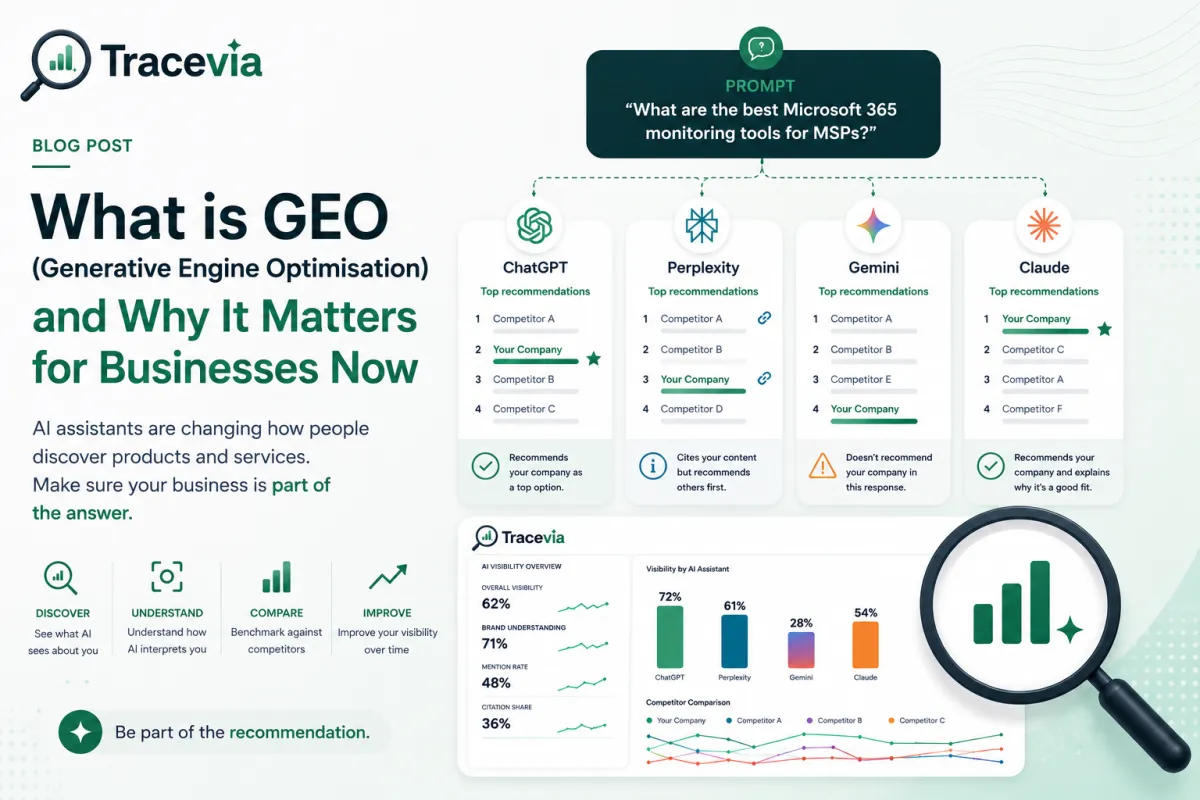
ChatGPT, Gemini, Claude and Perplexity use different models, retrieval mechanisms, search technologies and sources.
Give all four exactly the same prompt and you shouldn't assume they will produce the same recommendations.
One might recommend your company first.
Another might mention you as an alternative.
A third might cite your website without recommending you.
And the fourth might not mention you at all.
Your GEO performance therefore isn't simply:
"Are we visible in AI?"
A more useful question is:
"How visible are we across the AI assistants our potential customers use?"
That is why measuring multiple engines and multiple prompts is important.
What Does GEO Actually Involve?
GEO is still an emerging discipline, so it would be misleading to pretend there is a universally agreed checklist that guarantees results.
However, several principles are already becoming clear.
Your website needs to communicate clearly what your organisation does. Product and solution pages should answer real customer questions rather than relying entirely on marketing language. Important information should be accessible to crawlers where appropriate. Structured data can help machines interpret entities and relationships. Consistent terminology helps reinforce what products and capabilities mean.
Content also needs to demonstrate genuine expertise.
If customers regularly ask a particular question during the buying process, answering that question clearly on your website gives both humans and machines useful context.
External authority matters too.
AI systems don't have to rely exclusively on what you say about yourself. Reviews, articles, directories, discussions, documentation and other authoritative third-party sources can contribute to how a business is understood.
There are also emerging mechanisms such as llms.txt that attempt to provide AI systems with clearer routes into important website content. These can form part of an AI-readiness strategy, but they shouldn't be viewed as a substitute for good content, technical accessibility or authority.
GEO is therefore better understood as a combination of technical accessibility, content clarity, entity understanding, authority and measurement.
You Cannot Improve What You Don't Measure
This is where GEO becomes particularly interesting.
With conventional SEO, businesses have spent years measuring rankings, impressions, clicks, backlinks and organic traffic.
GEO requires a different set of signals.
You need to know which prompts matter to your customers and then understand what AI assistants say when those questions are asked.
Does your company appear?
Are you recommended?
Where within the answer do you appear?
Which competitors are recommended?
Which sources are cited?
Does the assistant understand your business correctly?
How does your visibility differ between ChatGPT, Gemini, Claude and Perplexity?
And how does all of that change over time?
A single test isn't enough.
Generative systems evolve. Models change. Search indexes change. Competitors publish new content. Your own website changes.
AI visibility therefore needs to be treated as something that can be measured, understood and improved continuously.
From GEO Theory to Measurable AI Visibility
This is the problem Tracevia is designed to help solve.
Tracevia measures how businesses appear across ChatGPT, Gemini, Claude and Perplexity using the questions that matter to their customers.
Rather than treating GEO as an abstract optimisation exercise, the objective is to establish a measurable baseline.

Measure how visible you are across relevant AI assistants.
Understand how those systems perceive your brand, products and capabilities.
Improve the content, authority and information that may be limiting your visibility.
Then measure again to understand whether those changes are working.
Repeat
GEO shouldn't be a one-off project.
AI systems, competitors and customer behaviour are constantly changing, which means AI visibility needs to be treated as a continuous process.
From Search Rankings to AI Recommendations
For years, one of the most important digital marketing questions has been:
"Where do we rank on Google?"
That question isn't disappearing.
But it is being joined by another:
"When someone asks AI about a problem we solve, are we part of the recommendation?"
That is ultimately what Generative Engine Optimisation is about.
The businesses that understand this transition early have an opportunity to establish authority while the way customers discover products and services is still changing.
Because the future of online visibility isn't simply about being easy to find.
It is about being understood, trusted and recommended.
And if AI is increasingly helping your customers decide what to buy, you need to know what AI is saying about you.

