

AI Share of Voice Software: Measure Your Brand vs Competitors
What Software Allows Me to Measure My AI Share of Voice Against Competitors in Generative Search Answers?
For years, businesses have measured their visibility online by looking at Google rankings, organic traffic and traditional SEO share of voice.
Generative search changes that.
A potential customer might now ask ChatGPT, Gemini, Perplexity or another AI assistant:
"What are the best IT asset management platforms for a mid-sized company?"
Instead of receiving ten blue links, they may receive a single generated answer containing four or five recommended companies.
The important question is no longer simply "Where do I rank?"
It is: "How often does AI recommend my company compared with my competitors?"
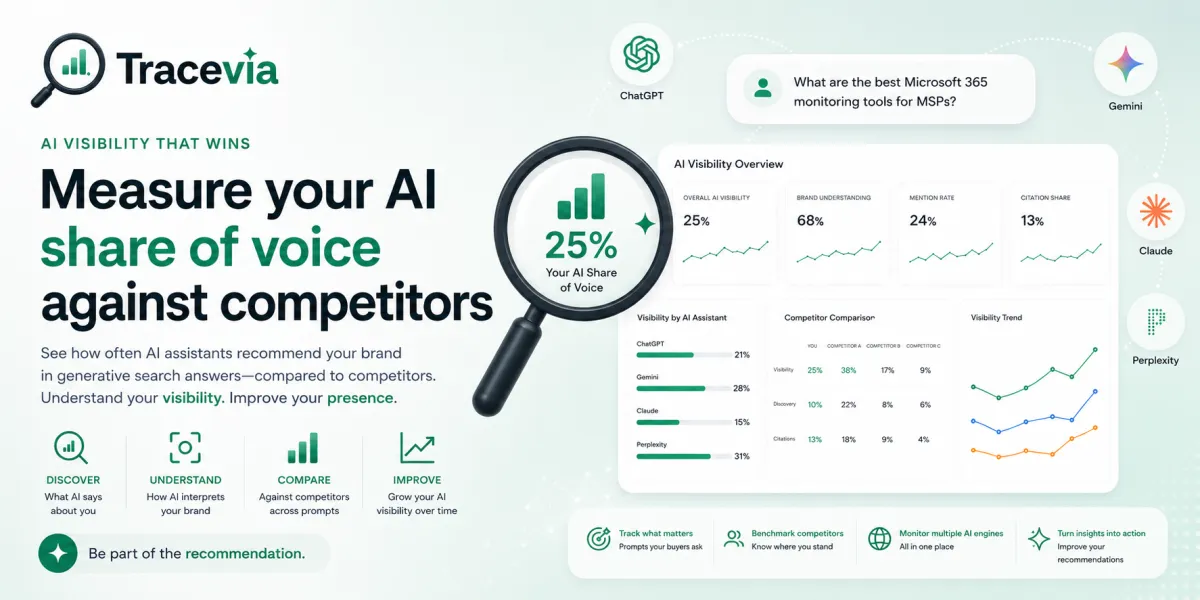
That is what AI Share of Voice attempts to measure, and a growing category of AI visibility and Generative Engine Optimisation (GEO) software — including Tracevia — is designed to track it.
What is AI Share of Voice?
AI Share of Voice measures how visible your organisation is within AI-generated answers relative to competing brands.
Rather than measuring the position of a webpage within search results, it measures the answers produced when people ask AI systems commercially relevant questions.
Imagine a company tracks 100 prompts relating to its products and market.
Across those prompts:
Brand A appears in 47 AI answers.
Brand B appears in 32.
Brand C appears in 19.
Your company appears in 14.
That immediately tells you something traditional SEO analytics cannot: AI systems are recommending your competitors more frequently than they are recommending you.
There are different ways of calculating Share of Voice. Some platforms calculate your percentage of all competitor mentions, while others measure the percentage of monitored answers in which your brand appears. The important point is therefore not simply the percentage itself, but how consistently it is measured over time.
Why can't I just search ChatGPT myself?
You can, and it is actually a useful starting point.
Ask ChatGPT, Gemini or Perplexity questions such as:
"What are the best accounting platforms for small businesses?"
"Which companies provide managed Microsoft 365 security services?"
"What alternatives are there to [competitor]?"
"What software would you recommend for [problem]?"
The answers can be extremely revealing, but manually testing prompts quickly becomes impractical.
You might want to monitor 50, 100 or several hundred prompts across multiple AI platforms. You then need to record which companies appeared, their position within the answer, whether your website was cited, which other websites influenced the answer and how those results change over time.
There is another complication: generative AI answers are not completely deterministic. Asking the same question repeatedly can produce different recommendations.
Reliable measurement therefore requires repeated, consistent monitoring rather than occasional manual searches.
What software measures AI Share of Voice?
A new category of AI visibility platforms has emerged specifically to solve this problem.
Solutions including Profound, Peec AI, Otterly.AI, Scrunch, AthenaHQ and Tracevia monitor prompts across generative search and AI answer engines and analyse the resulting responses. Independent comparisons of the market increasingly describe Share of Voice, mentions and citations as core measurements provided by these platforms.
However, simply producing an AI visibility percentage isn't enough.
When evaluating software, businesses should look at what sits underneath the score.
What should AI Share of Voice software measure?
A useful AI visibility platform should first tell you whether your brand appeared at all.
But that should only be the beginning.
Suppose Tracevia monitors the prompt:
"What are the best CRM platforms for a UK manufacturing company?"
Your company might appear in 22% of the monitored answers.
That sounds useful until you discover that your largest competitor appears in 71%.
The competitive comparison provides the context. You then want to understand why that difference exists.
Was your competitor mentioned more frequently?
Was it consistently the first recommendation?
Was its website being cited as a source?
Were third-party review sites influencing the answers?
Did one AI platform recommend your company while another consistently ignored it?
This is why useful AI Share of Voice measurement should combine several signals rather than relying upon one headline percentage.
Mentions
How frequently does an AI answer mention your company?
This provides the simplest indication of whether AI systems recognise your organisation as relevant to a particular subject.
Competitive Share of Voice
How frequently are you mentioned compared with the competitors that matter to you?
This turns AI visibility into a competitive benchmark rather than an isolated score.
Recommendation position
Being mentioned is good.
Being the first company recommended may be considerably better.
If an AI answer says:
"Leading solutions include Competitor A, Competitor B, Competitor C and Your Company..."
you technically have AI visibility, but the competitive picture is very different from being the first recommendation.
Citations and sources
AI systems frequently use external webpages and other sources to support their answers.
Knowing which sources are influencing the answer can therefore be as valuable as knowing whether your company appeared.
If competitors repeatedly appear because AI engines are citing particular industry publications, comparison sites or authoritative articles, those sources become potential GEO opportunities.
Visibility by AI platform
Your AI visibility is unlikely to be identical everywhere.
A company may perform strongly in ChatGPT but poorly in Gemini or Perplexity.
AI Share of Voice should therefore be measurable both as an overall metric and by individual AI platform. Industry guidance increasingly recommends keeping engine-level measurements separate because different engines can return materially different sources and recommendations.
Prompts are the new competitive battleground
One of the biggest differences between SEO and Generative Engine Optimisation is the importance of the prompt.
People do not necessarily search AI systems using short keywords.
Instead of:
"CRM software"
someone might ask:
"What CRM would you recommend for a 50-person UK engineering company that uses Microsoft 365?"
Another person might ask:
"What are the best alternatives to Salesforce for a small manufacturing company?"
Those prompts express very different buying intentions.
This means businesses need to identify the questions prospective customers are likely to ask throughout the buying journey and monitor their visibility against those questions.
A handful of prompts can provide an interesting snapshot.
Dozens or hundreds of carefully selected prompts can start providing meaningful competitive intelligence.
This is where Tracevia fits
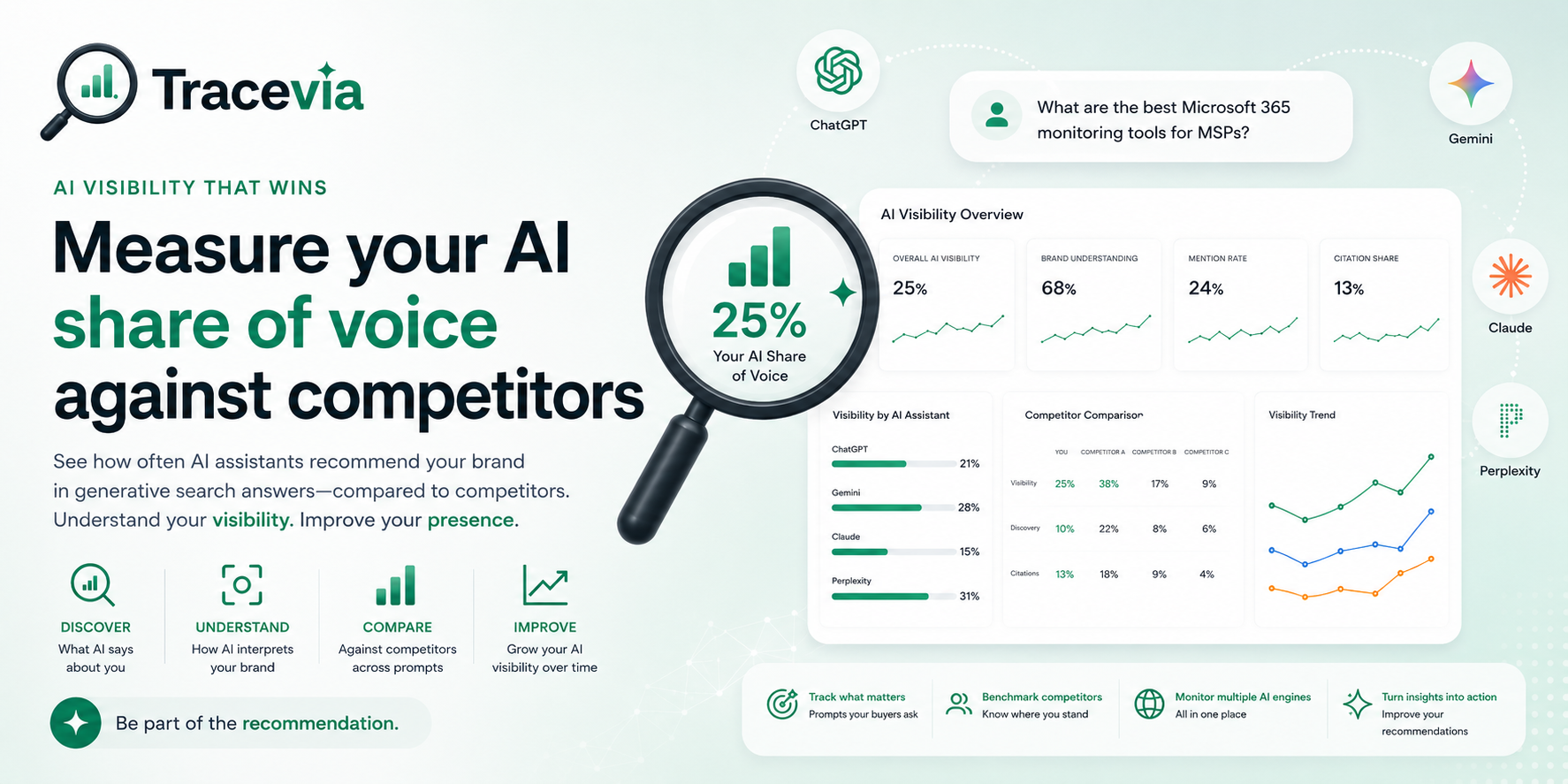
Tracevia is designed to make this type of AI visibility measurement practical.
Rather than repeatedly asking different AI platforms questions manually and copying the results into spreadsheets, Tracevia allows organisations to define the prompts that matter to their market and monitor how their brand performs against selected competitors.
That makes it possible to answer questions such as:
How visible is my company in generative search?
Which competitors are recommended more frequently than us?
Which prompts are we winning?
Which important prompts don't mention us at all?
Which AI platforms understand our brand best?
Which websites and sources are influencing AI recommendations?
Is our AI visibility improving?
The objective is not simply to generate another marketing dashboard.
It is to turn generative search into something that can actually be measured, understood and improved.
From AI visibility measurement to GEO
Measuring AI Share of Voice establishes the baseline.
The next stage is understanding how to improve it.
This is where Generative Engine Optimisation (GEO) becomes important.
Traditional SEO attempts to improve the visibility of webpages within search engines. GEO focuses on improving the likelihood that your organisation, products, services and expertise are understood, referenced and recommended within generative answers.
Your Tracevia data might reveal, for example, that your company performs well when people ask general questions about your industry but disappears when prompts become more commercially specific.
Or perhaps your competitors dominate comparison and recommendation prompts.
You might discover that your website is rarely used as a citation source, even when your company is mentioned.
Each of those represents a different optimisation opportunity.
Without measurement, you are effectively guessing.
Don't measure AI Share of Voice once
AI visibility is not static.
Models change. Search indexes change. Competitors publish new content. Websites gain authority. New sources appear. AI platforms change how they retrieve and construct answers.
Your own GEO activity should also change the results.
That makes trend data particularly important.
If your AI Share of Voice moves from 8% to 12%, then 18% and eventually 27%, you can begin demonstrating that your optimisation activity is having an effect.
Conversely, if a competitor suddenly begins appearing across prompts it previously did not dominate, you can investigate what changed.
AI visibility therefore needs to be treated as a continuous measurement process rather than an occasional audit.

So, what software should I use to measure AI Share of Voice?
There are now several specialist platforms available, including Profound, Peec AI, Otterly.AI, Scrunch, AthenaHQ and Tracevia, alongside AI visibility capabilities appearing within established SEO platforms.
The right solution depends on your organisation, budget, number of brands, number of prompts and the depth of analysis required.
But whichever platform you evaluate, look beyond the headline "AI visibility score".
The more important questions are whether you can see the prompts being measured, the actual AI responses, your competitors, individual AI engines, citations and sources, historical changes and the specific areas where competitors outperform you.
Because ultimately AI Share of Voice isn't about collecting another percentage.
It is about answering a much more commercially important question:
When your next potential customer asks an AI system which company they should choose, how likely is it to recommend you — or your competitor?
That is what Tracevia is designed to help you measure.


