

AI Visibility: Why SEO Alone Is No Longer Enough
Search Engine Visibility Is No Longer Enough: Is Your Business Visible to AI?
AI Visibility: Why SEO Alone Is No Longer Enough
For more than two decades, being found online has largely meant one thing: being visible in search engines.
Businesses have invested heavily in SEO, content marketing, backlinks, structured data and technical optimisation to improve their position in Google and Bing. The objective was straightforward. When somebody searched for a product, service or answer relevant to your business, you wanted your website to appear as prominently as possible.
That still matters.
But it is no longer the whole picture.
Increasingly, people aren't searching for websites. They're asking AI for answers and recommendations.
Instead of searching Google for "best Microsoft 365 monitoring tools for MSPs", someone might ask ChatGPT, Claude, Gemini or another AI assistant:
"What are the best Microsoft 365 monitoring platforms for an MSP managing 50 customers?"
The difference may appear subtle, but for businesses trying to attract new customers, it is enormous.
With traditional search, the user receives a list of websites and decides which ones to investigate.
With AI, the AI system may do much of that evaluation for them.
If your company isn't understood, trusted or recommended by AI, you may never make it onto the customer's shortlist.
From Search Engines to Answer Engines
Traditional search engines primarily help users find information.
AI assistants increasingly try to provide the answer.
That changes the customer journey.
Imagine someone looking for an IT monitoring platform. A traditional Google search might return ten organic results, several adverts, review websites and perhaps a selection of related questions.
The user then visits several websites, compares their capabilities and eventually builds a shortlist.
An AI assistant can compress much of that process into a single conversation.
The user can ask:
"What platforms should I consider?"
Then:
"Which of those are suitable for MSPs?"
Followed by:
"Which support Microsoft 365 monitoring?"
And finally:
"Which three would you recommend for a 20-person MSP?"
The AI is progressively filtering the market on the user's behalf.
For vendors, that creates an entirely new visibility challenge.
You don't simply need to rank. You need to be understood well enough to be considered.
SEO Isn't Dead — But It Has a New Job
The emergence of AI recommendations doesn't mean SEO is disappearing.
Quite the opposite.
A well-structured, authoritative website remains extremely important. Search engines, AI-powered search experiences and AI assistants all need reliable information from which they can understand businesses, products and topics.
Good SEO therefore remains part of the foundation.
But traditional measurements such as keyword rankings, organic traffic and search impressions no longer tell you everything about your digital visibility.
A business could rank extremely well in Google while being almost invisible when customers ask AI systems for recommendations.
The reverse can also happen.
A relatively small company may appear prominently in AI-generated answers because its website clearly explains what it does, independent sources discuss it, its product is associated with a particular problem, and its information is easy for machines to understand.
This introduces another question alongside:
"Where do we rank in Google?"
Businesses increasingly need to ask:
"What does AI know about us?"
From SEO to GEO: Generative Engine Optimisation
The need to become visible within AI-generated answers has led to an emerging discipline often called Generative Engine Optimisation, or GEO.
If Search Engine Optimisation (SEO) is about improving your visibility when someone searches, GEO is about improving the likelihood that your organisation, products or expertise are understood, referenced and recommended by generative AI systems.
There is considerable overlap between the two. High-quality content, clear website structure, authority, relevance and accurate information remain important. But the desired outcome is different.
With SEO, success might mean reaching the first page of Google for an important search term.
With GEO, success might mean being included when someone asks an AI assistant:
"What are the best solutions for this problem?"
or:
"Which vendors should I consider?"
That changes how we need to think about optimisation. It is no longer enough to ask which keywords a page ranks for. We also need to understand whether AI systems correctly associate a business with the problems it solves, whether they recognise its expertise and whether they consider it sufficiently relevant to include in an answer or recommendation.
GEO is also sometimes discussed alongside terms such as Answer Engine Optimisation (AEO) and AI Search Optimisation. The terminology is still evolving, but they all reflect the same fundamental change: online discovery is expanding beyond the traditional list of search results.
For businesses, that creates a new optimisation cycle.
First, understand how AI currently perceives and represents your organisation. Then identify where competitors are being recommended instead of you, determine why those gaps exist, make targeted improvements to your content and digital presence, and measure whether those changes improve future AI responses.
That is where GEO moves from theory into something measurable.
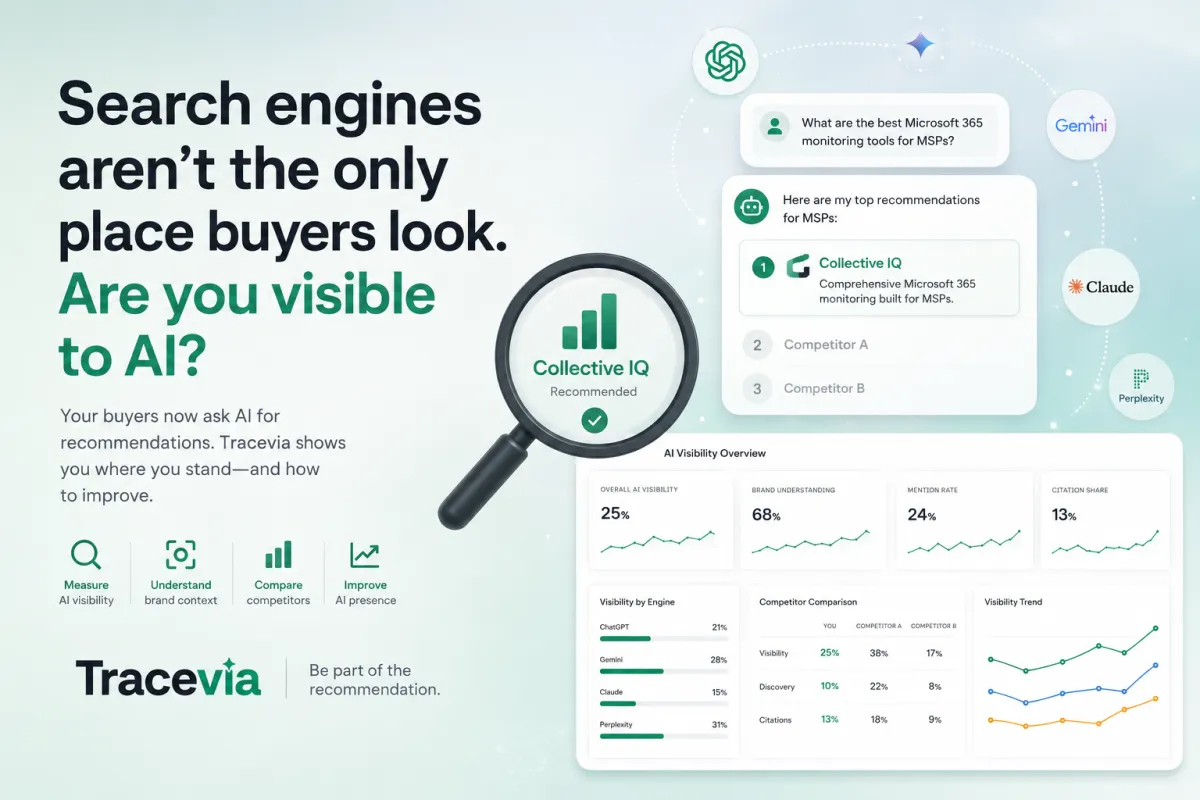
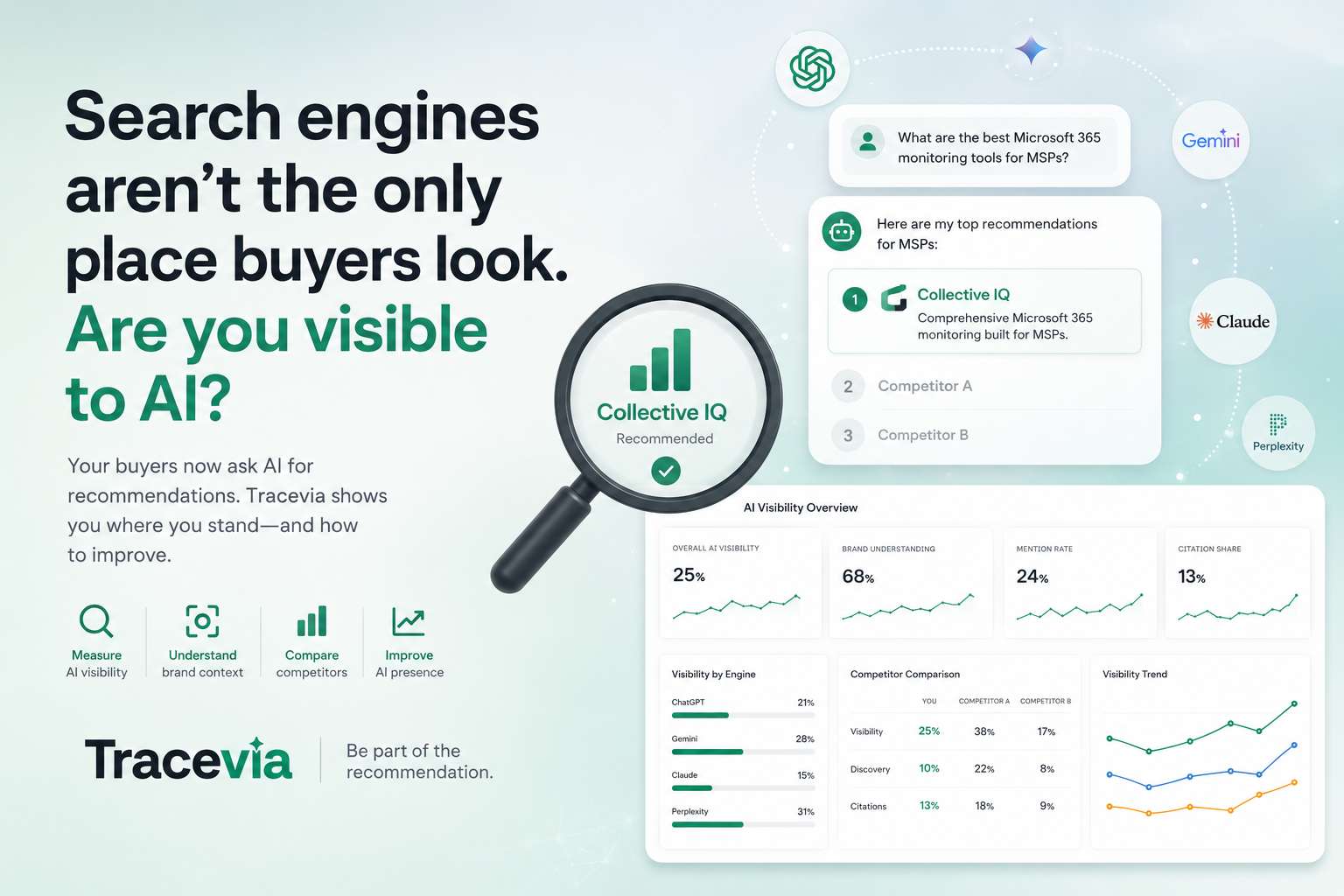
And it is also where platforms such as Tracevia become important. If you cannot see when AI systems recommend you, your competitors or neither of you, it is extremely difficult to know what needs improving — or whether your GEO efforts are actually working.
What Does an AI Think Your Company Does?
This is where AI visibility becomes particularly interesting.
Search visibility has historically been relatively easy to observe. Search for a keyword, inspect the results and measure where your website appears.
AI visibility is more complicated.
An AI system may know your company exists but misunderstand what you do.
It might correctly identify your company but fail to associate it with an important product category.
It might recommend three competitors and omit you entirely.
It might describe capabilities you discontinued two years ago.
Or it might understand your product perfectly but still recommend a competitor when asked which solution is best.
Each represents a different AI visibility problem.
Simply asking whether an AI has "heard of your company" therefore isn't particularly useful.
The more valuable questions are things such as:
Does AI understand what we do?
Which categories does it associate us with?
Which competitors appear alongside us?
Which questions cause our company to be recommended?
Which questions should result in a recommendation but don't?
How accurately are our products and capabilities represented?
And perhaps most importantly:
What can we change to improve those results?
AI Visibility Is About Recommendations, Not Just Mentions
A brand mention can be useful, but recommendations are significantly more valuable.
Consider two responses to a question about software.
In the first, an AI assistant mentions your company while explaining the market.
In the second, it actively includes your product among the three solutions a customer should evaluate.
Those aren't equivalent outcomes.
The second potentially places your company directly into a buying decision.
This is why AI visibility needs to go beyond simply counting brand mentions.
Businesses need to understand their recommendation visibility: how frequently they appear when AI systems are asked the questions that potential customers are likely to ask.
That also means understanding the competitive context.
If your company appears in 30% of relevant AI recommendations, is that good?
Perhaps.
But if your closest competitor appears in 80%, there is clearly an opportunity to investigate why.
Your Website Now Has Two Audiences
Websites have traditionally been designed around two audiences: humans and search engines.
AI effectively introduces another.
Your website still needs to convince a prospective customer. It still needs to be discoverable by search engines. But increasingly it also needs to communicate clearly with systems trying to understand what your organisation does.
That makes clarity particularly important.
A beautifully designed website filled with vague marketing language might work reasonably well for a human who already understands the company. It can be far less useful to a machine trying to determine exactly which problems the product solves.
Clear product descriptions, feature pages, solution pages, FAQs, structured data and authoritative educational content can all contribute to creating a clearer picture of your organisation.
Emerging approaches such as llms.txt also attempt to make important website information easier for AI systems and automated agents to discover, although AI visibility should never be reduced to simply adding a single file to your website.
The bigger objective is to create a consistent, machine-understandable representation of who you are, what you do and why you are relevant.
The Challenge: How Do You Measure It?
This is the problem we created Tracevia to address.
Businesses already have mature tools for measuring search visibility. We can monitor rankings, impressions, backlinks, traffic, technical SEO and hundreds of other metrics.
AI recommendations are much harder to see.
Tracevia is designed to help organisations understand how they appear across the emerging AI discovery landscape.
Rather than simply asking whether a brand has been mentioned, Tracevia focuses on the questions that matter commercially.
What happens when an AI is asked to recommend products in your market?
Are you included?
Which competitors are recommended?
How are you described?
What capabilities are associated with your company?
Where are the gaps?
And crucially, what could you change to improve your AI visibility?
This turns AI visibility from an interesting experiment into something that can be measured and improved.
From AI Visibility to GEO
Measuring AI visibility tells you where you are today. GEO is the process of improving what happens next..
Knowing that your company isn't being recommended is useful. Understanding why and knowing what to do next is considerably more valuable.
Perhaps your website never clearly connects your product with a particular use case.
Maybe competitors have stronger independent references around an important topic.
Perhaps your product pages don't answer the questions prospective customers are asking.
There may be inconsistent descriptions of your company across different sources.
Or an AI system may simply lack enough reliable information to confidently recommend you.
These are very different problems requiring very different responses.
The opportunity is therefore not simply AI monitoring. It is AI visibility optimisation.
Measure how AI sees the business, identify gaps, make targeted improvements and then measure whether those changes affect future recommendations.
Search Visibility + AI Visibility
For businesses, the conclusion shouldn't be that AI replaces Google.
Customers will use both.
Someone might discover a company through ChatGPT, research it through Google, read independent reviews, return to an AI assistant to compare products and finally visit the vendor's website.
Discovery is becoming fragmented across search engines, AI assistants, social platforms, marketplaces and specialist communities.
That means digital visibility needs to evolve as well.
SEO answers:
Can people find us when they search?
AI visibility adds another increasingly important question:
Will AI recommend us when they ask?
The companies that understand both will have a significant advantage as AI becomes a larger part of how people research products, compare suppliers and make purchasing decisions.
Can AI Find, and Recommend, Your Business?
The shift from search engines to AI-assisted discovery is already underway.
Your prospective customers are asking AI systems about the problems they need to solve, the products available to them and the vendors they should consider.
The important question is no longer simply whether your website appears on page one of Google.
It is whether your business appears in the answer.
Tracevia helps you discover how AI sees your business, measure where and when you are recommended, compare your visibility with competitors, and identify opportunities to improve your presence in AI-generated answers.
Because in an AI-driven world, being online isn't enough.
You need to be part of the recommendation.

