Why Traditional SEO Is Failing in AI Search | Tracevia
Why Are Traditional SEO Strategies Failing to Capture Market Share in AI-Driven Search Engines?
Why Traditional SEO Is Failing in AI Search | Tracevia
For more than two decades, the objective of search marketing has been relatively straightforward: understand what people search for, create content around those searches, build authority and improve your position in search engine results. That model still matters, but the way people discover businesses, products and services is changing.
Instead of searching Google for “best project management software for a small business” and opening several websites, a potential buyer can now ask ChatGPT, Gemini, Claude or Perplexity:
“What are the best project management platforms for a 50-person professional services company?”
They may then continue:
“Which of those would you recommend if Microsoft 365 integration is important?”
And finally:
“Compare the top three and tell me which one you would choose.”
The user may make it from initial research to a shortlist without visiting a traditional search results page at all.
This creates a fundamental challenge for businesses that have spent years investing in SEO.
You can rank well in traditional search and still be almost invisible in AI-driven discovery.
The reason is that traditional SEO was primarily designed to answer one question:
How do we get our web page ranked?
AI visibility introduces a different question:
How do we get our business understood, considered and recommended?
That difference is becoming increasingly important.
SEO Isn't Dead — But Search Has Changed
It would be easy to conclude that AI means traditional SEO no longer matters. That would be a mistake. Search engines, websites, technical SEO, quality content, backlinks, structured data and authoritative third-party references all continue to contribute to how information about a business is discovered and understood.
The problem is that traditional SEO addresses only part of the new discovery environment. Historically, search visibility was heavily associated with where a webpage appeared in a list of results.
Position 1 was better than position 5. Position 5 was considerably better than position 25.
AI-generated answers work differently.
There may be no list of ten results. Instead, an AI system might identify three products, explain their differences and recommend one of them. Suddenly the challenge isn't moving from position seven to position four. It is getting included in the answer at all.
From Ranking Pages to Recommending Brands
Traditional search engines predominantly help users locate information.
Generative AI systems increasingly attempt to interpret that information for them.
Consider a buyer researching cybersecurity platforms.
A traditional search might produce links to vendor websites, review platforms, analyst content, comparison articles and advertisements. The buyer decides which links to open and gradually builds their own shortlist.
With generative search, the AI can perform part of that interpretation itself.
A user might simply ask:
“Which cybersecurity platforms are best suited to a mid-sized UK company?”
The AI response could immediately identify several vendors and explain why each might be appropriate.
That changes the unit of competition.
Your webpage is no longer necessarily competing for a click.
Your brand is competing for inclusion in the AI's answer.
And that requires a broader approach than optimising individual pages around keywords.
Keywords Are Not the Same as Understanding
Traditional SEO has historically placed considerable emphasis on keywords and search intent.
If people search for “Microsoft 365 monitoring software”, for example, a vendor might create a page specifically optimised around that phrase.
That remains useful. But AI systems also need to understand relationships between concepts.
They need to establish associations such as:
Company → Product → Category → Capability → Use Case → Audience → Evidence
Imagine a fictional company called AcmeCloud.
Its website repeatedly says that AcmeCloud provides “next-generation intelligent digital transformation solutions.”
That might sound impressive in marketing copy.
But what exactly does the company do?
Compare that with a much clearer information footprint:
AcmeCloud provides Microsoft 365 monitoring software for managed service providers. It monitors security, licensing, user activity and configuration across multiple customer tenants.
The second description gives AI systems much stronger semantic relationships to work with.
This is one reason AI visibility is closely connected to entity understanding.
It isn't enough for your website to contain relevant words.
AI systems need to develop confidence about who you are, what you do, who you serve and why they should consider you.
Your Website Is Only Part of Your AI Footprint
Another major difference between SEO and AI visibility is where information about your company exists. Businesses naturally focus heavily on their own websites because those are the digital properties they control.
AI systems can potentially encounter information about a company across a much broader ecosystem. That might include industry publications, product documentation, customer reviews, software directories, comparison sites, news articles, community discussions, social platforms, partner websites and other authoritative references.
This creates an important distinction between what a company says about itself and what the wider information ecosystem says about the company.
Suppose your website describes your product as a leading solution within its market.
That is a claim.
If independent sources repeatedly associate the product with that category, discuss its capabilities and compare it favourably with established competitors, the information ecosystem provides much stronger evidence for that association.
For AI visibility, your objective therefore extends beyond optimising your own website.
You need to understand your overall digital footprint.
The Competitive Set Has Become Much Smaller
Traditional search results offer businesses multiple opportunities for visibility.
Even if you aren't the first result, users may still scroll, compare several sites or modify their search.
AI answers can compress that competitive landscape dramatically.
Ask:
“What are the best AI visibility platforms?”
An AI system might mention three or four companies.
If your business is number five in the model's perceived competitive set, there may be no fifth position displayed. You simply aren't mentioned. This makes AI Share of Voice particularly important.
Instead of asking only:
Where do we rank for this keyword?
Businesses increasingly need to ask:
How often are we mentioned when potential customers ask relevant questions?
And then:
How often are our competitors mentioned instead?
Those are very different measurements.
Traditional SEO Metrics Don't Show the Whole Picture
Google Search Console, analytics platforms and traditional SEO tools provide enormous amounts of valuable information.
They can show search impressions, keyword rankings, clicks, backlinks, organic traffic and conversions.
But consider a user who opens ChatGPT and asks:
“Which AI visibility platforms should I evaluate?”
Suppose the response recommends three of your competitors.
Your website analytics record nothing.
There was no visit.
Search Console records nothing.
There was no Google impression.
Your rank-tracking software records nothing.
There was no conventional search results page.
Yet a potential customer has just encountered three competitors and not your business.
That is a genuine visibility event, and potentially a lost commercial opportunity, that traditional SEO measurement may never see. This is one of the biggest blind spots created by generative search.
SEO vs GEO: What's the Difference?
The emerging discipline designed to address this problem is commonly called Generative Engine Optimisation (GEO).
SEO and GEO overlap considerably, but they measure success differently.
Traditional SEO | Generative Engine Optimisation |
|---|---|
Improve search rankings | Improve AI visibility |
Optimise webpages | Optimise brand and entity understanding |
Target keywords | Target questions, topics and concepts |
Measure search positions | Measure AI mentions and recommendations |
Analyse organic competitors | Analyse AI Share of Voice |
Generate search clicks | Generate consideration and inclusion |
Build backlinks | Build authoritative references and citations |
Measure website traffic | Measure presence across AI answers |
The important point is that businesses shouldn't necessarily choose between SEO and GEO. They complement each other.
Strong technical SEO, useful content and authoritative websites can help create the information foundation from which AI systems can understand a company.
GEO expands that strategy beyond ranking webpages.
From Search Queries to Customer Questions
There is another subtle change businesses need to consider. Traditional SEO strategies often begin with keyword research.
Generative search increasingly revolves around questions and conversations.
A prospective customer might begin with:
“What tools can help me understand how my company appears in ChatGPT?”
Then ask:
“Which ones allow competitor comparison?”
Then:
“Which would work best for a small marketing team?”
And finally:
“Which one would you recommend?”
These aren't simply four keywords. They represent a buying journey.
For businesses trying to understand their AI visibility, this means monitoring individual prompts is useful, but monitoring groups of prompts representing real customer intent can be much more revealing.
A company might appear frequently for broad informational questions but disappear when users move towards comparison or purchase-intent questions.
That distinction matters.
The New Question: Does AI Recommend Us?
This ultimately changes how businesses should think about digital visibility.
For traditional SEO, a marketing team might track twenty important keywords and celebrate when several move onto page one.
For AI visibility, the questions become more strategic.
When potential customers ask about our market, are we mentioned?
Are competitors mentioned more frequently?
How does the AI describe us?
Does it understand what our product actually does?
Are our important capabilities recognised?
Which sources does it rely upon?
Does it associate us with the correct market category?
And perhaps most importantly:
When someone asks for a recommendation, are we part of the shortlist?
You cannot answer those questions by looking at Google rankings alone.
Measure Before You Optimise
This is where AI visibility platforms such as Tracevia become useful. Before attempting to improve Generative Engine Optimisation, businesses need a baseline.
Tracevia allows organisations to monitor the prompts and questions that matter to their market and analyse how they appear within AI-generated answers. Instead of simply tracking where a webpage ranks, businesses can begin measuring questions such as:
Are we mentioned?
Which competitors are mentioned?
How frequently do we appear compared with them?
How does our AI Share of Voice change over time?
What sources appear to influence those answers?
That creates a continuous process:
Measure → Understand → Improve → Measure Again

The objective isn't to replace SEO analytics.
It is to expose an entirely new layer of visibility that traditional SEO tools were never designed to measure.
The Businesses That Adapt Early Have an Advantage
Generative search is still developing rapidly. That creates uncertainty, but it also creates an opportunity.
Many organisations spent years competing for established Google search positions where incumbent websites had accumulated enormous domain authority and backlink profiles.
AI-driven discovery creates a new competitive surface.
The brands that understand how they are represented within AI answers today have an opportunity to improve that presence while many competitors are still measuring digital visibility exclusively through traditional search rankings.
The first step isn't necessarily changing your entire content strategy. It is discovering what AI systems already believe about your market and your business, because you cannot improve visibility that you aren't measuring.
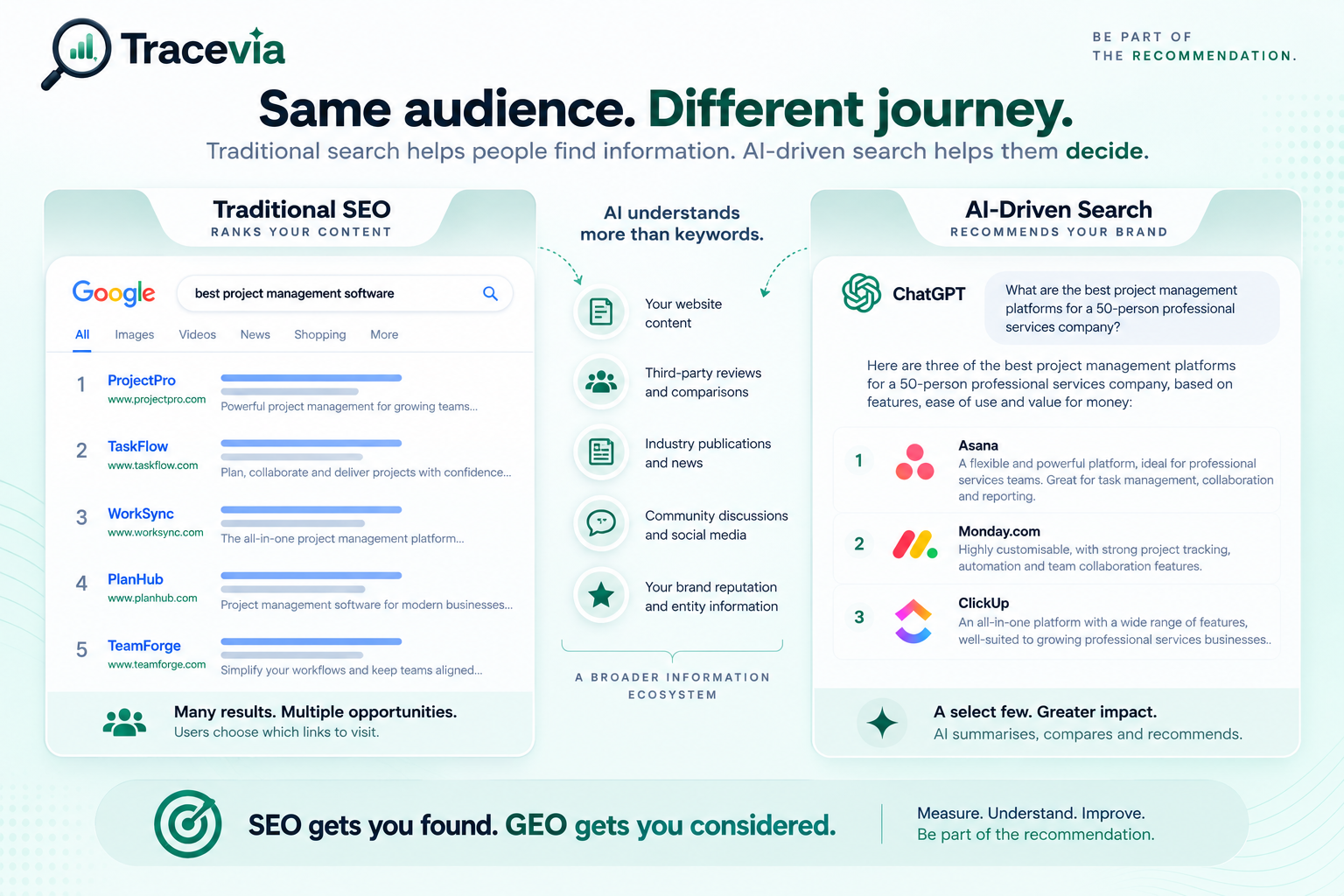
SEO Gets You Found. GEO Gets You Considered.
Traditional SEO isn't disappearing. People will continue searching the web, visiting websites and using conventional search engines. However the customer discovery journey is expanding.
Businesses now need visibility in both environments.
SEO asks:
“Can customers find my website?”
GEO adds another increasingly important question:
“When customers ask AI what they should buy, does it recommend my business?”
For businesses competing in AI-driven search, that may ultimately become one of the most important questions in digital marketing.


