Which AI Search Results Matter Most for Your Brand?
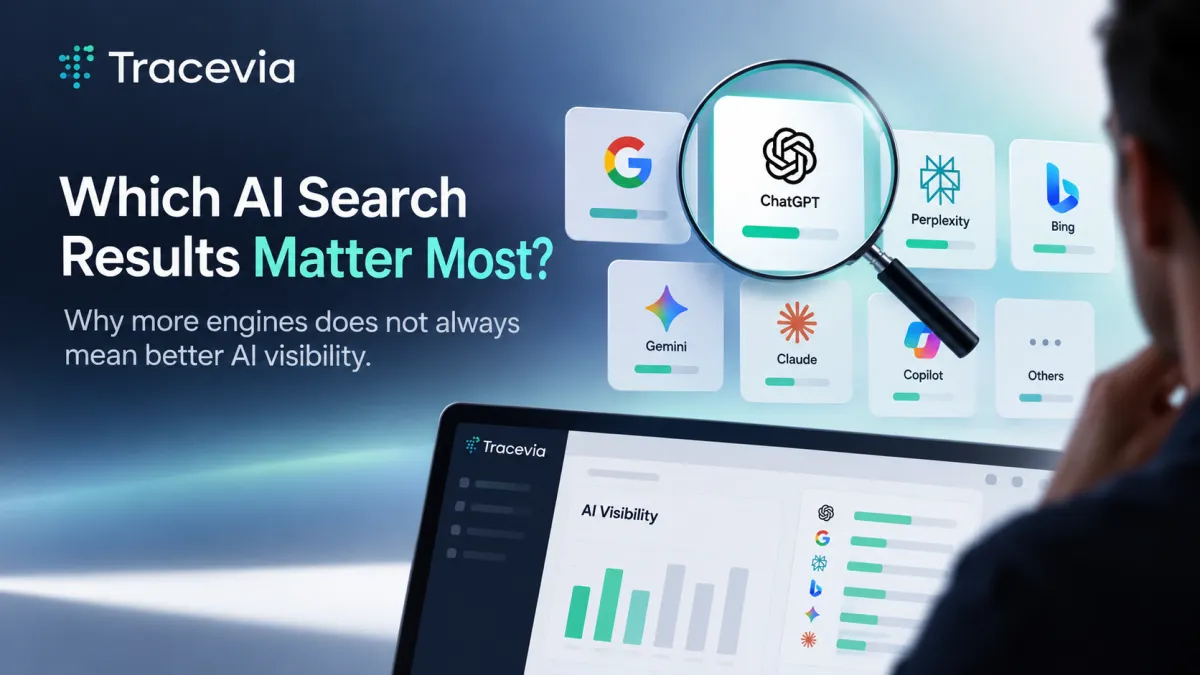
Which AI Search Results Matter Most? Why More Engines Does Not Always Mean Better AI Visibility
Which AI Search Results Matter Most for Your Brand?
As businesses start measuring their visibility in AI-generated answers, one of the first questions they encounter is surprisingly simple:
How many AI engines should we be monitoring?
Some AI visibility platforms monitor four engines. Others monitor six, nine or more. It is tempting to assume that the platform checking the largest number must provide the most complete picture.
But that misses a much more important question:
Which AI engines actually matter to your audience?
If your customers overwhelmingly use one particular platform when researching products, suppliers or technical questions, your visibility on that platform could be far more commercially important than your average visibility across every AI engine available.
AI visibility therefore shouldn't just be about measuring everywhere. It should be about understanding where visibility matters most.
Not all AI engines have equal value to every business
Consider two companies.
The first sells highly technical software to developers and IT professionals. Its prospective customers may frequently use specialist AI assistants or answer engines such as Perplexity when researching technologies and comparing products.
The second sells a mainstream consumer product. Its potential customers may rarely visit a dedicated AI assistant. Instead, their first encounter with an AI-generated recommendation could happen directly inside Google or Bing.
Both companies need to understand AI visibility. But they don't necessarily need to give every AI engine the same importance.
For the first company, poor visibility within Perplexity could represent a significant gap even if the brand performs strongly elsewhere.
For the second, visibility within AI-generated search experiences associated with Google or Bing could potentially matter far more.
The question isn't simply:
"Are we visible in AI?"
It is:
"Are we visible in the AI experiences our audience actually uses?"
The danger of the simple average
Suppose a company monitors six AI engines and receives the following visibility scores:
Engine | Visibility |
|---|---|
Engine A | 82% |
Engine B | 76% |
Engine C | 71% |
Engine D | 68% |
Engine E | 74% |
Engine F | 18% |
The average looks reasonably healthy. But what happens if Engine F is responsible for a large proportion of the AI-assisted research performed by the company's target audience?
Suddenly the average is misleading.
The business doesn't really have a "65% AI visibility" problem.
It has an 18% visibility problem on the engine that matters most.
This is why AI visibility metrics need context. Averages are useful for understanding overall presence, but they should never hide significant weaknesses within strategically important channels.
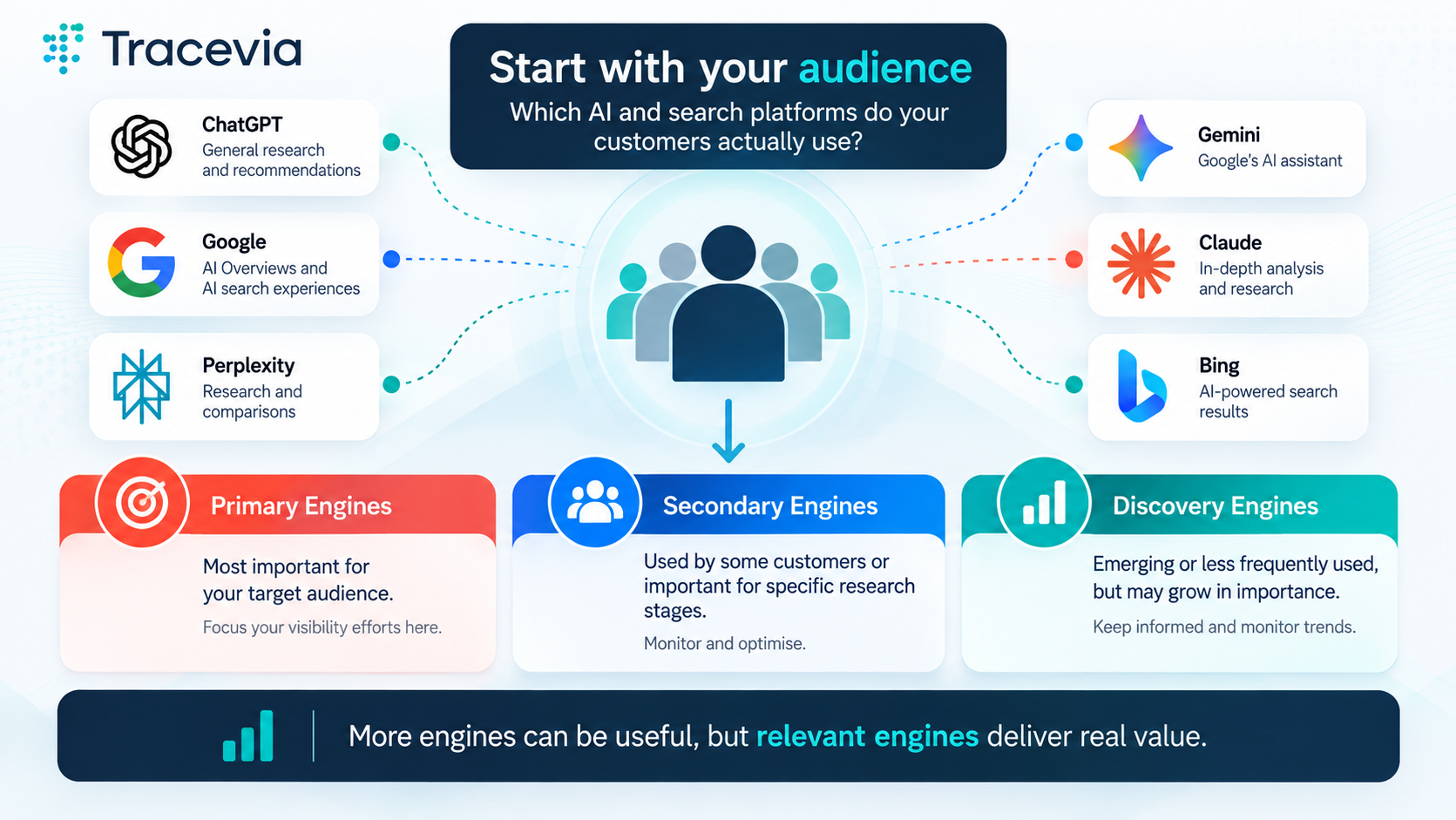
Start with your audience, not the engine list
When deciding which results matter most, start with the people you are trying to influence — not the number of logos displayed on an AI visibility dashboard.
Ask questions such as:
Who is our target audience?
How do they research products, services and suppliers?
Do they primarily begin with traditional search?
Are they increasingly using dedicated AI assistants?
Are particular AI platforms especially popular within our industry?
Are customers asking AI broad discovery questions or detailed technical questions?
At what point in the buying journey are AI-generated answers being used?
The answers may be very different between industries.
A developer evaluating an API, a CIO researching cybersecurity products and a consumer looking for a new washing machine may all use AI-assisted search very differently.
That means the relative importance of each AI engine will also be different.
Don't underestimate Google and Bing
The rapid growth of ChatGPT, Perplexity, Gemini and other AI assistants can make it easy to think that traditional search is being replaced overnight. The reality is more nuanced.
For most people, Google or Bing remains the starting point for discovering information.
What is changing is what happens after the search.
Search engines increasingly incorporate AI-generated answers, summaries and recommendations directly into the search experience. This means businesses need to think about search visibility and AI visibility as increasingly interconnected rather than entirely separate disciplines.
A potential customer does not necessarily need to consciously decide:
"I am going to use an AI assistant to research this product."
They may simply search as they always have and encounter an AI-generated response.
For some businesses, that makes visibility within AI-enhanced search particularly important because it sits directly within an already established customer behaviour.
But specialist audiences can behave very differently
This is where industry context becomes critical.
Imagine a market where professionals routinely use Perplexity to investigate suppliers, technologies and emerging trends.
In that environment, visibility within Perplexity could be disproportionately valuable.
A company might rank well in Google and appear frequently in several other AI assistants but consistently fail to appear when those professionals ask Perplexity questions such as:
"What are the best platforms for solving this problem?"
or:
"Which vendors should I consider for this requirement?"
That gap matters.
Conversely, another company's audience might barely use Perplexity at all.
For that company, the same visibility gap might be considerably less significant.
There is therefore no universal answer to the question of which AI engine matters most.
Six relevant engines can tell you more than nine irrelevant ones
This also raises an important issue when comparing AI visibility platforms.
Engine count is an easy feature to compare. Relevance is harder.
A platform monitoring nine AI engines does not automatically provide better insight than one monitoring six.
Additional engines can certainly provide useful information. They can reveal differences between AI ecosystems, identify emerging platforms and provide early warning of changing behaviour.
But simply adding engines to increase a number on a comparison table does not necessarily create additional business value.
The better question is:
Does the platform measure the AI experiences that matter to my customers?
Six highly relevant sources may provide substantially more actionable insight than nine where several have little or no influence over your target market.
Different engines also tell you different things
There is another reason to avoid reducing AI visibility to a single score.
Different AI systems do not necessarily produce the same answer.
They may use different models, search indexes, retrieval mechanisms, source selection processes and approaches to understanding entities and brands.
A brand could therefore be strongly represented in one ecosystem but poorly understood in another. Those differences are useful. They can help reveal whether a visibility problem is broad or specific.
If your brand is consistently absent everywhere, you may have a fundamental entity, authority, content or discoverability problem.
If you perform strongly across five engines but poorly on one, the problem may be more specific to how that ecosystem discovers or interprets your organisation.
That is actionable information.
Think about AI visibility as a portfolio
A useful way to approach this is to think of AI visibility as a portfolio rather than a league table.
Your organisation might classify engines as:
Primary engines — platforms heavily used by your target audience and therefore strategically important.
Secondary engines — platforms used by some customers or important for particular stages of research.
Discovery engines — emerging or less frequently used platforms worth monitoring because their importance could increase.
That classification should not remain static.
AI adoption is changing rapidly. An engine that is relatively unimportant to your audience today could become an important discovery channel in six months.
Monitoring a broader range of engines can therefore still be valuable.
The important distinction is between monitoring an engine and giving its results equal strategic weight.
This is where Tracevia fits
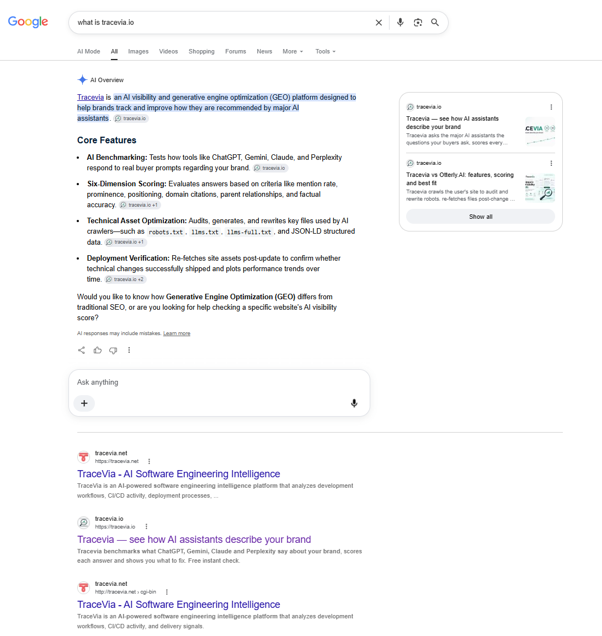
Tracevia (tracevia.io) is designed to help businesses understand how they appear across multiple AI and AI-assisted discovery environments.
But the objective is not simply to collect the largest possible number of results. The objective is to turn those results into useful visibility intelligence.
That means looking beyond an overall score and examining questions such as:
Where are we visible?
Where are we missing?
Which competitors are being recommended instead?
Do different engines understand our brand differently?
Which visibility gaps matter most to our particular audience?
This allows businesses to move from simply measuring AI visibility to understanding its commercial significance.
The next step: weighted AI visibility
As AI visibility measurement matures, one of the most useful developments will be moving beyond simple averages towards weighted visibility.
Instead of treating every engine as equally important, organisations could assign greater significance to the platforms most relevant to their customers.
For example, a technically focused B2B company might decide that its audience behaviour means Perplexity and ChatGPT deserve greater attention.
Another organisation might determine that AI-generated results appearing through Google and Bing represent its most important discovery channels.
The resulting visibility measurement would better reflect the organisation's actual market rather than an arbitrary average across AI platforms.
Importantly, those weightings should be based on evidence wherever possible, customer research, referral data, analytics, sales conversations and changes in audience behaviour, rather than assumptions.
So how many AI engines should you monitor?
There isn't a magic number.
Four might be enough for one organisation.
Six might be appropriate for another.
Nine may provide useful additional intelligence for another.
More coverage can certainly be valuable, particularly while the AI discovery landscape is evolving so quickly.
But the number of engines monitored should never become the objective itself.
The real objective is understanding whether your organisation is visible when potential customers ask the questions that matter, in the places where they are actually asking them, because ultimately:
Being visible everywhere is useful. Being visible where your customers are looking is essential
Frequently Asked Questions
Final thought
The next phase of AI visibility measurement will not be about asking:
"How many engines do you monitor?"
It will be about asking:
"Which engines matter to my customers — and how visible am I there?"
That distinction turns AI visibility from another marketing metric into something much more useful: an understanding of whether your brand is present at the moments when potential customers are asking AI for answers.


