

Why ChatGPT, Gemini, Claude & Perplexity Give Different Answers
Why ChatGPT, Perplexity, Gemini and Claude Give Different Answers to the Same Question
Why ChatGPT, Gemini, Claude & Perplexity Give Different Answers
Ask Google a question and, although rankings change, we broadly understand what is happening: Google searches its index, ranks relevant pages and presents a set of results.
Ask the same question to four AI assistants and something rather different happens.
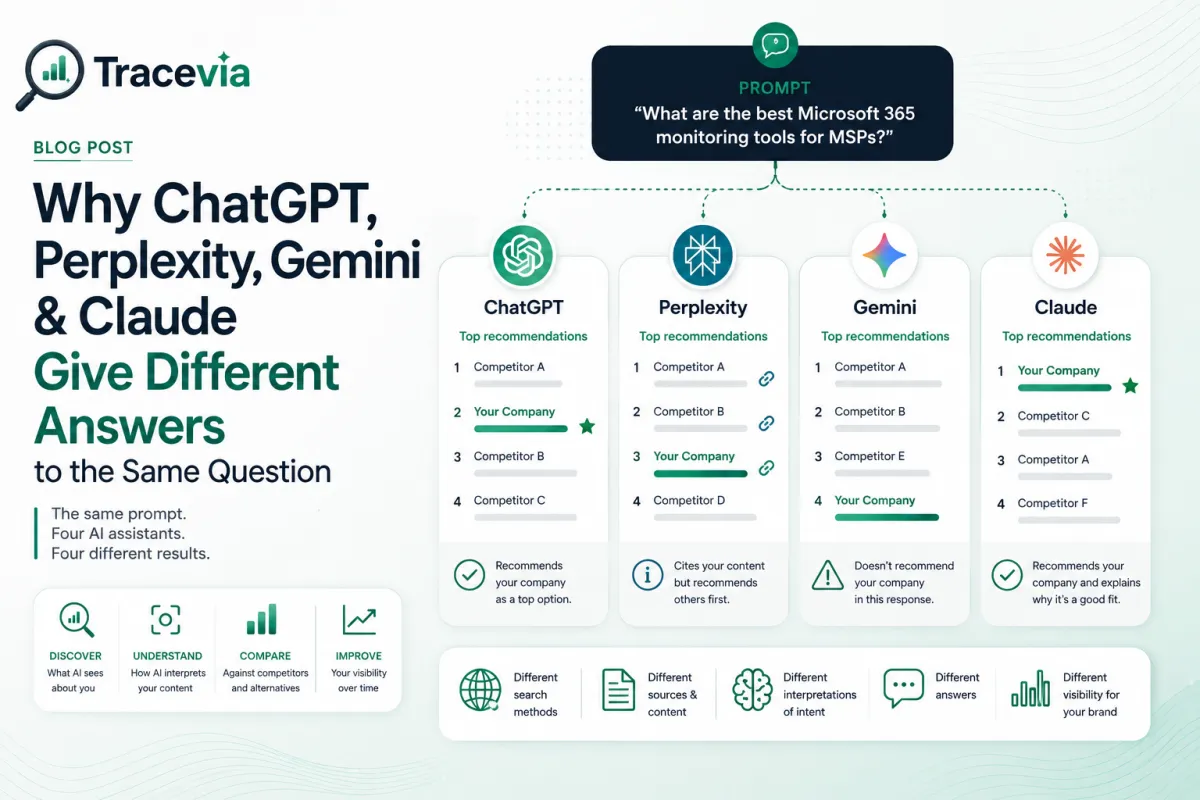
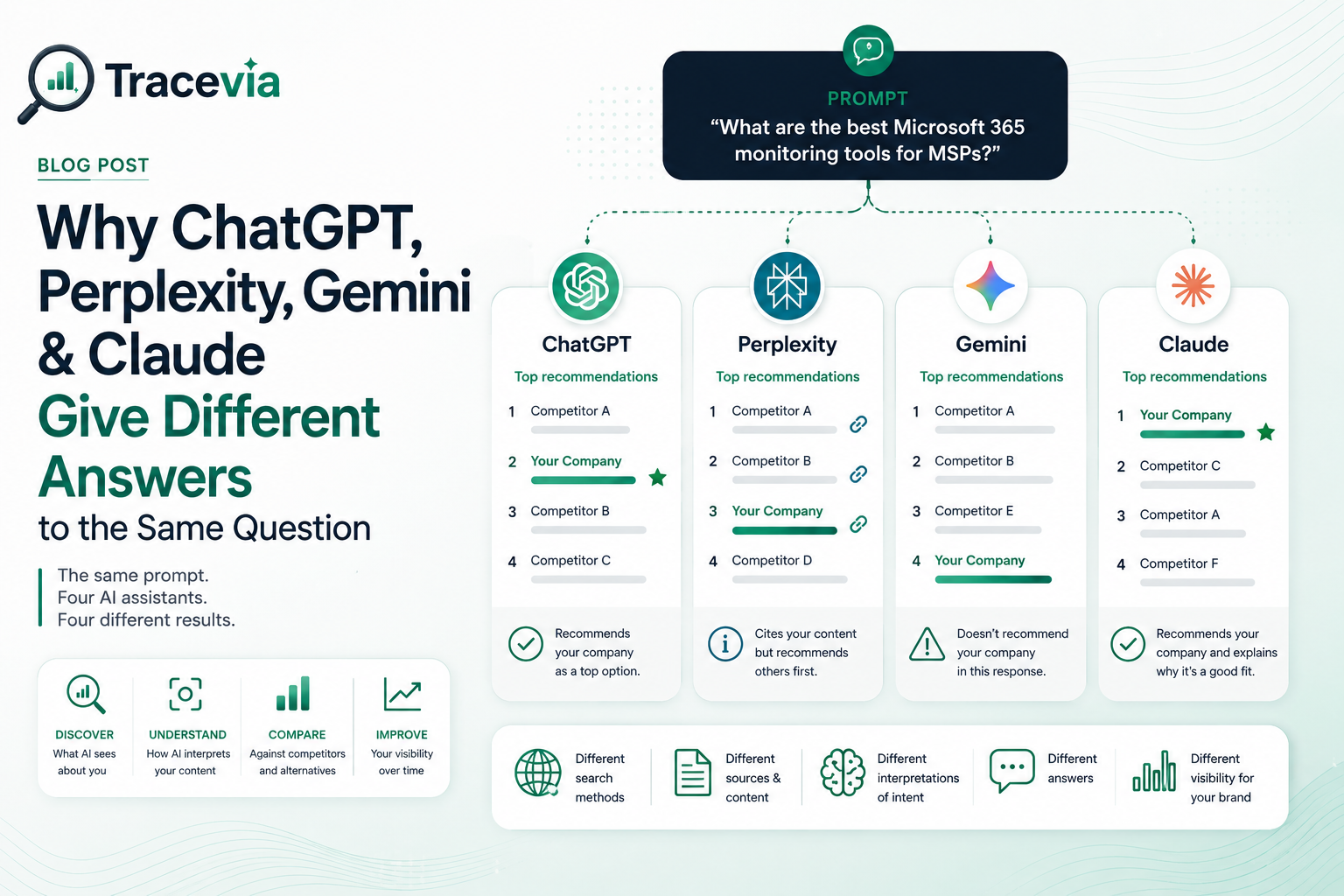
A prompt such as:
“What are the best Microsoft 365 monitoring tools for MSPs?”
could produce noticeably different recommendations depending on whether you ask ChatGPT, Perplexity, Gemini or Claude.
One assistant might recommend your company. Another might recommend three competitors but not you. A third might mention you further down the answer. Another might describe your product accurately but recommend a different vendor.
Run the prompt again next week and the results may change again.
This isn't necessarily an error. It is a consequence of how generative AI assistants discover information, select sources, interpret questions and construct their answers.
For businesses trying to understand their visibility in AI-generated recommendations, that difference is extremely important.
There Isn't One AI Search Engine
It is tempting to talk about "AI search" as though it were a single channel.
It isn't.
ChatGPT, Perplexity, Gemini and Claude are separate platforms built by different companies, using different models, search and retrieval systems, data sources and methods for deciding what information should contribute to an answer.
They also don't simply retrieve ten webpages and display them in ranked order.
Instead, an AI assistant may interpret the intent behind a question, search for relevant information, retrieve content from multiple sources, evaluate that information and then synthesise an entirely new response.
That means two assistants can start with exactly the same prompt and finish with very different answers.
This is why Tracevia monitors visibility across four major AI assistants: ChatGPT, Perplexity, Gemini and Claude.
ChatGPT
ChatGPT combines OpenAI's language models with the ability to search the web when current information would improve an answer. ChatGPT Search can transform a user's question into one or more targeted searches before using the retrieved information to construct its response.
This distinction matters.
The question entered by the user isn't necessarily identical to the searches performed behind the scenes.
For example:
User prompt:
"What are the best tools for monitoring Microsoft 365 across multiple customers?"
The assistant could interpret this as being about MSPs and investigate concepts such as multi-tenant Microsoft 365 monitoring, Microsoft 365 security monitoring or MSP cloud-management platforms.
The sources discovered through those searches can influence which companies ultimately appear in the answer.
Perplexity
Perplexity has positioned itself particularly strongly around AI-powered search and research.
Its answers are commonly built around information retrieved from the web, with citations allowing users to investigate the underlying sources.
As a result, Perplexity can sometimes surface companies, articles and specialist websites differently from a more conversational AI assistant.
For a business, appearing in the sources that Perplexity discovers can therefore be as interesting as appearing in the final recommendation.
You might discover that your competitor is repeatedly recommended because its comparison pages, documentation or third-party coverage are being found and referenced more frequently.
That becomes actionable intelligence.
Gemini
Gemini is Google's AI assistant and operates within Google's much broader information ecosystem.
Like the other assistants, Gemini isn't simply another interface for a traditional list of search results. It interprets the user's request and generates a response.
This creates an interesting distinction between traditional Google visibility and Gemini visibility.
A company can perform well in conventional search results without necessarily receiving equivalent prominence within an AI-generated recommendation.
Conversely, a brand that isn't number one in conventional search might still be selected by an AI assistant as a particularly appropriate recommendation for a specific question.
This is one of the reasons traditional SEO rankings alone cannot tell you how visible your company is becoming in AI-generated answers.
Claude
Claude is Anthropic's AI assistant and provides another independent perspective on the same prompt.
Like ChatGPT and Gemini, Claude can reason about the intent of a question rather than simply matching keywords.
That distinction becomes particularly important with complex commercial questions.
Consider:
"Which Microsoft 365 monitoring platform would be suitable for a 20-person MSP managing 50 customer tenants?"
This isn't simply a search for the phrase Microsoft 365 monitoring.
The assistant needs to understand concepts including MSPs, multi-tenancy, scalability, likely pricing considerations and the operational requirements of managing multiple customers.
Different AI models may place different importance on those factors — and consequently recommend different products.
Why Do the Results Differ?
There isn't one simple reason.
AI recommendations are influenced by several layers of information and decision-making.
Different models are the most obvious difference. ChatGPT, Gemini, Claude and Perplexity do not all use the same underlying models or reasoning systems. They can interpret the meaning and emphasis of a prompt differently.
Different search and retrieval mechanisms also matter. Even when assistants have access to the web, they don't necessarily search it in exactly the same way or retrieve the same pages.
Different sources can then produce different conclusions. One assistant might discover your product page. Another might discover a competitor comparison. Another might find a Reddit discussion, analyst article or software directory.
Different interpretations of intent can change the answer further. "Best AI visibility platform" could mean the most comprehensive platform, the cheapest, the best for an agency, the best for an enterprise or simply the most widely recognised.
Finally, AI answers are generated rather than retrieved. The system synthesises information into a response. It isn't simply displaying a fixed database record.
The result is a much more fluid discovery environment than businesses have become accustomed to with traditional search.
Your AI Visibility Is Therefore Not a Single Number
This leads to an important point.
A business doesn't simply have an "AI ranking".
You might have excellent visibility in ChatGPT but relatively poor visibility in Gemini.
You might frequently appear as a cited source in Perplexity without being included in the final recommendation.
Claude might recognise your brand but misunderstand an important product capability.
Even within the same assistant, your visibility can differ dramatically between prompts.
For example:
"What are the best AI visibility platforms?"
is different from:
"What are the best AI visibility platforms for an SEO agency?"
which is different again from:
"What software can track whether my company is recommended by ChatGPT and Gemini?"
These prompts may describe a similar underlying requirement, but they express very different user intentions.
That is why meaningful AI visibility measurement needs to examine prompts × assistants × responses over time, rather than checking whether a brand appears in one AI answer.
This Is What Tracevia Measures
Tracevia is designed around this new discovery model.
Rather than asking a single AI assistant whether it knows about your company, Tracevia can run relevant prompts across ChatGPT, Perplexity, Gemini and Claude and analyse the responses.
That allows you to see where your organisation is mentioned, which competitors are being recommended, how your brand is positioned and where visibility differs between assistants.
The differences are often where the most useful insights appear.
Imagine, for example, that your company appears in:
ChatGPT: 72% of relevant prompts
Perplexity: 61%
Gemini: 28%
Claude: 54%
The interesting question isn't simply:
"What's our AI visibility score?"
It is:
"Why is Gemini visibility so much lower?"
Perhaps Gemini isn't discovering an important section of your website. Perhaps competitors have stronger supporting content. Perhaps your product positioning isn't clear enough. Or perhaps authoritative external sources describe your competitors more frequently.
Those are things you can investigate and potentially improve.
AI Visibility Is About More Than Being Mentioned
There is another complication.
Simply appearing in an AI answer doesn't necessarily mean the answer is good for your business.
Consider these two responses:
"Tracevia is an AI visibility platform that monitors brand recommendations across major AI assistants."
and:
"Tracevia provides basic AI monitoring, although organisations requiring broader analysis may want to consider alternatives."
Both contain a brand mention.
Their commercial value is obviously very different.
This means AI visibility measurement should consider not only whether you appear, but also how you appear.
Are you recommended?
How prominently?
Which competitors appear alongside you?
What capabilities does the assistant associate with your company?
What sources influenced the response?
Is the information accurate?
And is that changing over time?
This moves AI visibility beyond simple mention tracking and towards understanding how AI systems perceive and represent your organisation.
Why Monitoring Multiple AI Assistants Matters
For many organisations, ChatGPT will understandably be the first AI platform they investigate.
But measuring ChatGPT alone risks creating a misleading picture.
Your potential customers aren't all using the same assistant.
Some will ask ChatGPT. Others will use Gemini because they already operate within Google's ecosystem. Some will use Claude. Others increasingly treat Perplexity as an alternative to conventional search.
Businesses therefore need to think about AI visibility in much the same way they already think about different marketing and discovery channels.
Being visible on one doesn't guarantee visibility on another.
And this fragmentation is likely to increase rather than disappear.
From Rankings to Recommendations
Traditional search marketing taught businesses to ask:
"Where do we rank?"
AI changes the question.
Increasingly, businesses need to ask:
"When someone asks an AI assistant about a problem we solve, are we part of the answer?"
And then:
"Which assistants recommend us, what do they say about us, which competitors appear instead, and why?"
There may never be a single universal answer.
That is precisely why measuring AI visibility across multiple assistants matters.
With Tracevia, the objective isn't to assume that ChatGPT, Perplexity, Gemini and Claude will agree.
It is to measure where they disagree, understand why, and identify what you can do to improve your visibility.
Because in the age of AI discovery, your next customer may never search for your company.
They may simply ask an AI who they should choose.

