

What Is llms.txt? A Guide to llms.txt, llms-full.txt & AI Visibility
What Is llms.txt? A Practical Guide to Making Your Website Easier for AI to Understand
What Is llms.txt? A Guide to llms.txt, llms-full.txt & AI Visibility
Search is changing.
For years, businesses have optimised their websites primarily for traditional search engines. Today, people are increasingly asking questions directly of AI systems such as ChatGPT, Claude, Gemini and AI-powered search experiences.
Instead of searching for ten blue links and deciding which one to visit, a user might ask:
“What are the best Microsoft 365 monitoring tools for MSPs?”
or:
“Which accounting platforms are suitable for a UK manufacturing company with 100 employees?”
The AI system researches the subject, interprets information from multiple sources and constructs an answer.
For businesses, that creates a new challenge: does AI understand your company, your products and the content on your website well enough to include you in that answer?
This is part of the growing discipline generally referred to as AI visibility or Generative Engine Optimisation (GEO).
One emerging technology designed to help AI systems understand websites is llms.txt.
What is llms.txt?
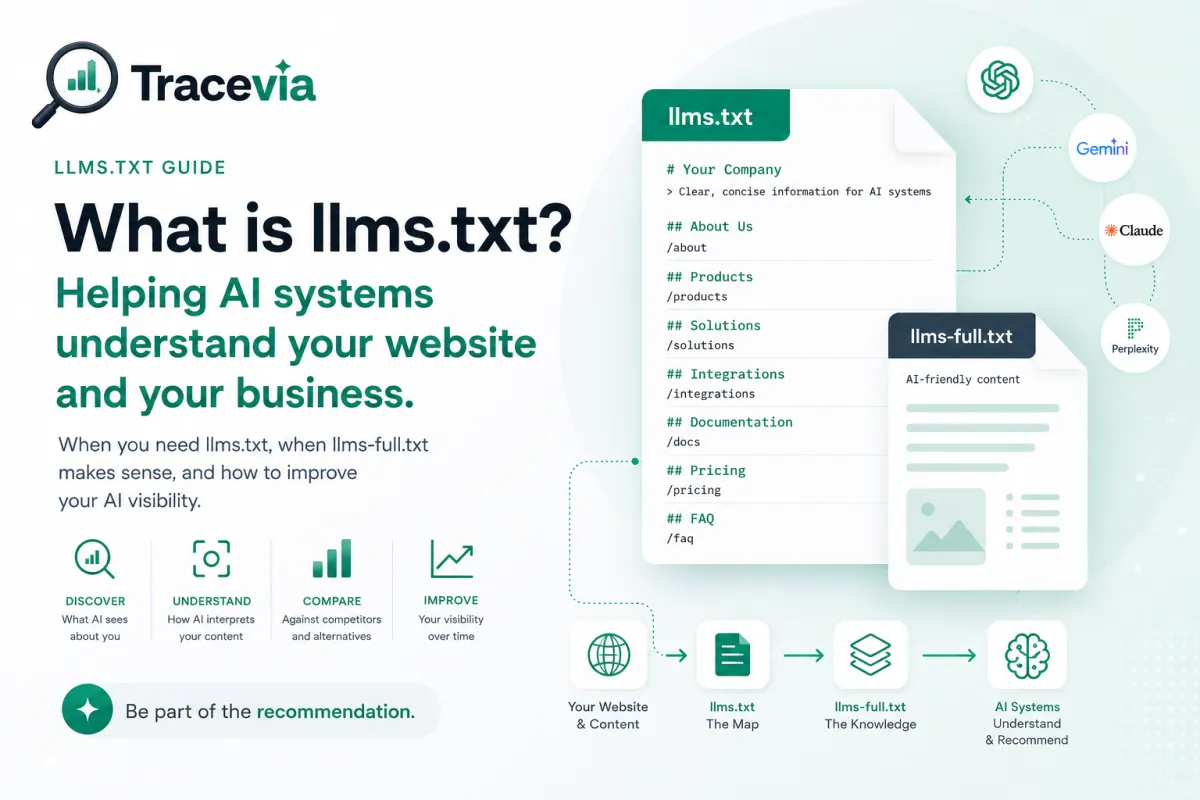
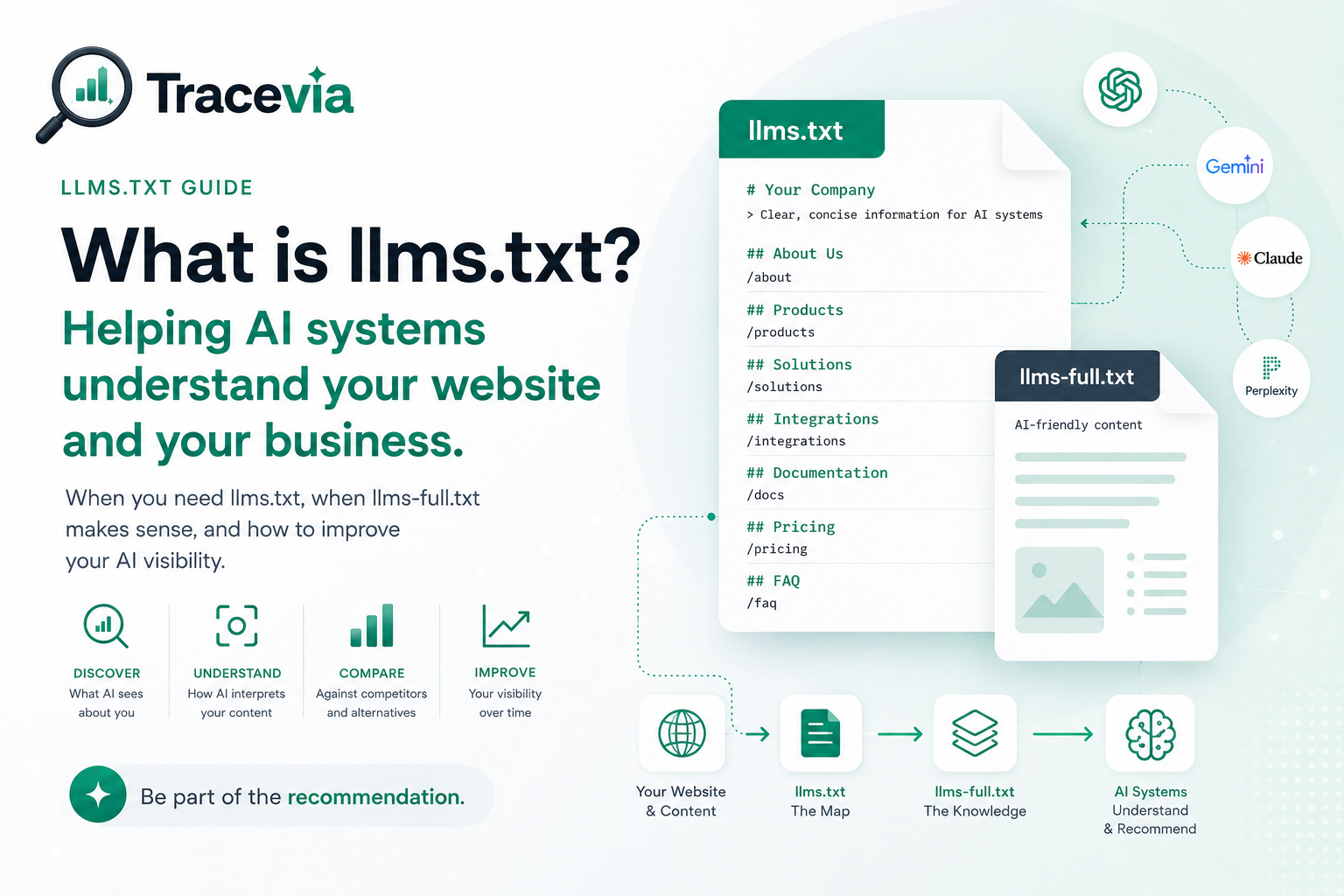
llms.txt is a proposed open convention for providing AI systems and agents with a concise, structured description of the important information available on a website.
The proposal was originally published by Jeremy Howard in September 2024 and is documented at https://llmstxt.org/ and has subsequently evolved as adoption has increased.
The basic concept is simple.
A website publishes a file such as:
https://example.com/llms.txt
The file uses Markdown, a simple text format that is particularly easy for large language models to process.
Rather than forcing an AI agent to interpret navigation menus, JavaScript, advertising, cookie notices and the rest of a modern web page, llms.txt gives it a cleaner route to the information that matters.
The current llms.txt proposal describes the file as a concise overview containing background information, guidance and links to more detailed, preferably AI-friendly content.
Is llms.txt the robots.txt for AI?
It is a useful analogy, but technically it isn't quite correct.
A robots.txt file primarily tells automated crawlers which parts of a website they are permitted to access.
An llms.txt file has a different job.
It helps an AI system understand what information is available and where the useful information can be found.
Similarly, sitemap.xml and llms.txt serve different purposes.
A sitemap attempts to describe the pages available on a website for search engines. An llms.txt file should be much more selective. It can highlight the pages that provide the best explanation of your company, products, services, documentation or expertise.
A useful way of thinking about the three is:
robots.txt → What can automated systems access?
sitemap.xml → What pages exist?
llms.txt → What should an AI system understand and where should it look?
They complement each other rather than replace each other.
What does an llms.txt file contain?
At its simplest, an llms.txt file begins with the name of the website or project, followed by a short description.
It can then organise important resources into sections.
For a SaaS company, for example, those sections might include:
About the company
Product information
Features
Use cases
Integrations
Documentation
Pricing
Security and compliance
Frequently asked questions
Important educational content
The objective isn't to reproduce the entire website.
In fact, doing so would defeat much of the purpose.
The goal is to give an AI agent a curated map of your most useful information.
Imagine an AI agent trying to answer the question:
"Does this product support Microsoft 365 monitoring?"
A traditional crawler might discover dozens or hundreds of pages and have to determine which ones are relevant.
A well-designed llms.txt could point directly towards the Microsoft 365 feature page, integrations page, relevant documentation and supporting articles.
That reduces ambiguity and gives the AI system better context from which to work.
What is llms-full.txt?
You may also encounter another file called:
llms-full.txt
Although the names are similar, its purpose is different.
Where llms.txt acts primarily as a concise map or index, llms-full.txt is intended to provide substantially more of the underlying content directly.
Instead of simply saying:
Microsoft 365 Monitoring
→ Visit this page.
an llms-full.txt implementation can include the actual text explaining the feature.
This gives an AI system a large body of clean, machine-readable information without requiring it to visit and extract content from every individual web page.
The distinction can therefore be thought of as:
llms.txt = curated map
llms-full.txt = consolidated knowledge source
That doesn't mean every website needs both.
When do you need llms-full.txt?
For many ordinary business websites, a carefully constructed llms.txt is a sensible starting point.
If your site has 20 or 30 important pages explaining who you are, what you sell and the problems you solve, there may be little benefit in creating a huge consolidated file.
llms-full.txt becomes more interesting when the website contains a significant body of information that an AI agent may need to reference.
A software company with hundreds of documentation pages is a good example. API references, configuration guides, tutorials, troubleshooting articles and technical documentation may be distributed throughout the website.
Providing this information in an AI-friendly consolidated format can make retrieval easier.
The same can apply to businesses with substantial knowledge bases, technical product catalogues or large libraries of authoritative educational material.
There is, however, a trade-off.
More content isn't automatically better.
A huge file containing outdated articles, repetitive marketing copy and irrelevant information can introduce more noise rather than providing better context.
The objective should therefore be high-quality machine-readable context, not simply the largest possible file.
llms.txt doesn't guarantee AI visibility
This is perhaps the most important point.
Creating an llms.txt file does not mean that ChatGPT, Claude, Gemini or another AI platform will suddenly start recommending your business.
Nor should llms.txt be treated as a magic new form of SEO.
AI systems can discover and interpret information through many different mechanisms. They may use web search, indexes, crawled information, third-party sources, structured data, knowledge bases and other retrieval systems.
The current llms.txt specification is an emerging convention rather than a replacement for those mechanisms.
Publishing one therefore shouldn't be viewed as:
"We've added llms.txt, so our AI optimisation is complete."
It should be viewed as:
"We've made it easier for AI systems that support this approach to understand our authoritative content."
That is a much more realistic objective.
llms.txt is only one part of AI visibility
This is where the wider issue becomes particularly interesting.
A technically perfect llms.txt file doesn't tell you whether AI systems actually understand your company correctly.
For example, an AI model might still:
fail to mention your brand for important questions;
recommend competitors instead;
misunderstand one of your product capabilities;
associate your company with the wrong market;
reference outdated information;
describe your pricing incorrectly; or
cite third-party sources rather than your website.
Those are AI visibility problems rather than simply website configuration problems.
And you cannot solve them purely by creating another file.
You first need to measure them.
Measure how AI actually sees your brand
This is the principle behind Tracevia.
Rather than assuming that a particular technical optimisation will improve AI visibility, you can monitor the questions and prompts that matter to your business and see how AI systems actually respond.
For example, a business might track prompts around:
"What are the best AI visibility platforms?"
"Which tools can monitor brand visibility in ChatGPT?"
"How can I measure whether my company appears in AI recommendations?"
The important questions then become:
Are you mentioned?
How often are you mentioned?
Which competitors appear instead?
What position or prominence do you receive?
Which sources are influencing the answer?
How does the AI describe your company?
Does that change over time?
That provides a measurable baseline.
You can then make changes — improving important website pages, adding structured data, strengthening third-party authority, improving your llms.txt, creating better supporting content or publishing an llms-full.txt where appropriate — and measure again.
llms.txt and GEO
This is why llms.txt is increasingly discussed alongside Generative Engine Optimisation (GEO).
Traditional SEO asks:
"How do we improve our visibility in search engine results?"
GEO introduces another question:
"How do we improve our visibility, understanding and recommendation within AI-generated answers?"
llms.txt can help make your content easier for AI systems to navigate and interpret.
But GEO goes considerably further.
It involves making sure that information about your organisation is clear, consistent, authoritative and easy to verify across the sources that AI systems use.
Most importantly, it requires measurement.
Without measurement, you don't know whether the changes you are making are having any effect.
llms.txt, llms-full.txt or both?
There isn't a universal answer.
For a relatively small corporate website, start with llms.txt. Concentrate on clearly defining the organisation and directing AI systems towards your strongest product, service, solution and informational pages.
For a content-rich or technical website, consider providing AI-friendly Markdown versions of important pages and potentially an llms-full.txt resource where having consolidated content provides genuine value.
For a large website, resist the temptation to put everything into one enormous file. Curating authoritative information and providing clear routes to detailed content is generally more useful than simply exposing thousands of pages.
And whichever approach you take, keep the information current.
An AI-friendly file containing last year's products, old URLs or obsolete pricing isn't helping your visibility.
It may be doing precisely the opposite.
From AI optimisation to AI visibility
llms.txt represents an important change in how we think about websites.
For decades we have created websites primarily for two audiences: people and search engines.
We are increasingly dealing with a third:
AI agents.
Giving those agents clean, structured and authoritative information makes sense, and llms.txt provides a straightforward mechanism for doing so.
But publishing the file is the beginning rather than the end of the process.
The bigger question is whether AI systems actually understand, mention and recommend your organisation when potential customers ask relevant questions.
That requires a continuous process:
Measure → Understand → Improve → Measure again.

Tracevia helps organisations measure their visibility across AI platforms, understand how their brand and competitors appear in AI-generated answers, identify the sources influencing those responses and track how visibility changes over time.
Because the real objective isn't simply to make your website readable by AI.
It's to understand what AI is saying about you — and improve your chances of being part of the answer.

