Compare AI Visibility Tools & Platforms | Tracevia
Not All AI Visibility Platforms Are the Same: Introducing Tracevia Comparisons
Compare AI Visibility Tools & Platforms | Tracevia
Choosing between AI visibility tools is becoming increasingly difficult. As organisations look to understand how their brands appear in ChatGPT, Gemini, Claude, Perplexity and other AI experiences, a rapidly growing range of AI visibility platforms has emerged.
But there is an important point that can easily get lost when comparing feature lists:
AI visibility platforms are not all trying to solve exactly the same problem.
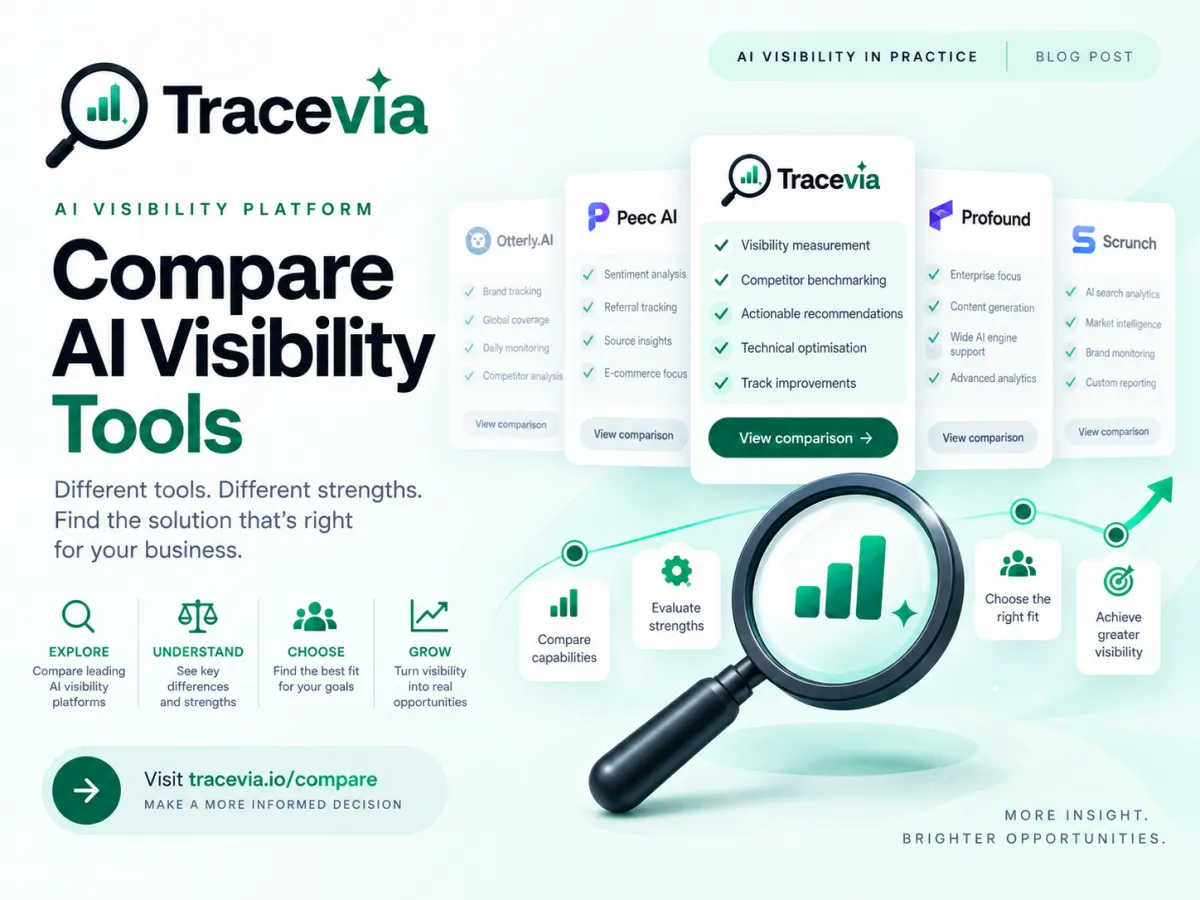
That is why we have launched the new Tracevia Comparison Pages.
Rather than simply creating another list of AI visibility products, the comparison pages look at how Tracevia and other platforms approach AI visibility, where their capabilities overlap, where they differ and, importantly, the types of requirement each product may be best suited to address.
The AI visibility market is already becoming diverse
At first glance, many AI visibility products appear similar. Most talk about concepts such as AI visibility, Generative Engine Optimisation (GEO), Answer Engine Optimisation (AEO), prompts, citations, mentions and share of voice.
Look more closely, however, and significant differences start to emerge.
Some platforms concentrate heavily on tracking brand mentions across as many AI engines as possible.
Others focus on sentiment, AI referral traffic or identifying the sources being cited by generative search engines.
Some extend into content creation and traditional SEO automation.
Others provide agency reporting, international monitoring or integrations with analytics and business intelligence platforms.
Tracevia takes another approach: combining AI visibility measurement with structured analysis and practical optimisation.
That includes benchmarking responses across major AI assistants, analysing those responses against a consistent six-dimension scoring model, identifying citation opportunities and helping organisations improve the technical information available to AI systems through assets such as llms.txt, llms-full.txt, robots.txt and JSON-LD.
Just as importantly, Tracevia can verify that technical changes have actually been deployed and then compare subsequent benchmark results to help determine whether those changes made a difference.
These are different approaches to a developing market—and that makes choosing a platform more complicated than comparing the number of prompts included in a subscription.
There isn't necessarily a single "best" AI visibility platform
This is one of the principles behind the new comparison section. When organisations evaluate established software categories, they generally don't expect every product to be identical.
A monitoring platform designed for a global enterprise isn't necessarily the right product for a small business. An SEO automation platform solves a different problem from an analytics platform. A tool designed primarily for agencies may have different priorities from one designed for an internal marketing team.
AI visibility software should be evaluated in the same way.
For example, an organisation primarily interested in daily international brand tracking may place a high value on tracking frequency and geographic coverage.
An e-commerce company might be particularly interested in AI shopping visibility, sentiment and measuring referral revenue.
An enterprise marketing department might prioritise very broad AI-engine coverage and automated content creation.
Another organisation may want to understand why its visibility is poor, identify technical and content issues, implement changes and then measure whether those changes actually improved how AI assistants represent the business.
Those are all legitimate requirements, but they don't necessarily lead to the same product.
Introducing the Tracevia Comparison Pages
The new Tracevia comparison area has been designed to make those differences easier to understand.
Rather than presenting an enormous feature matrix, the main comparison page provides a summary of each platform. You can then select an individual comparison to explore the differences in more detail.
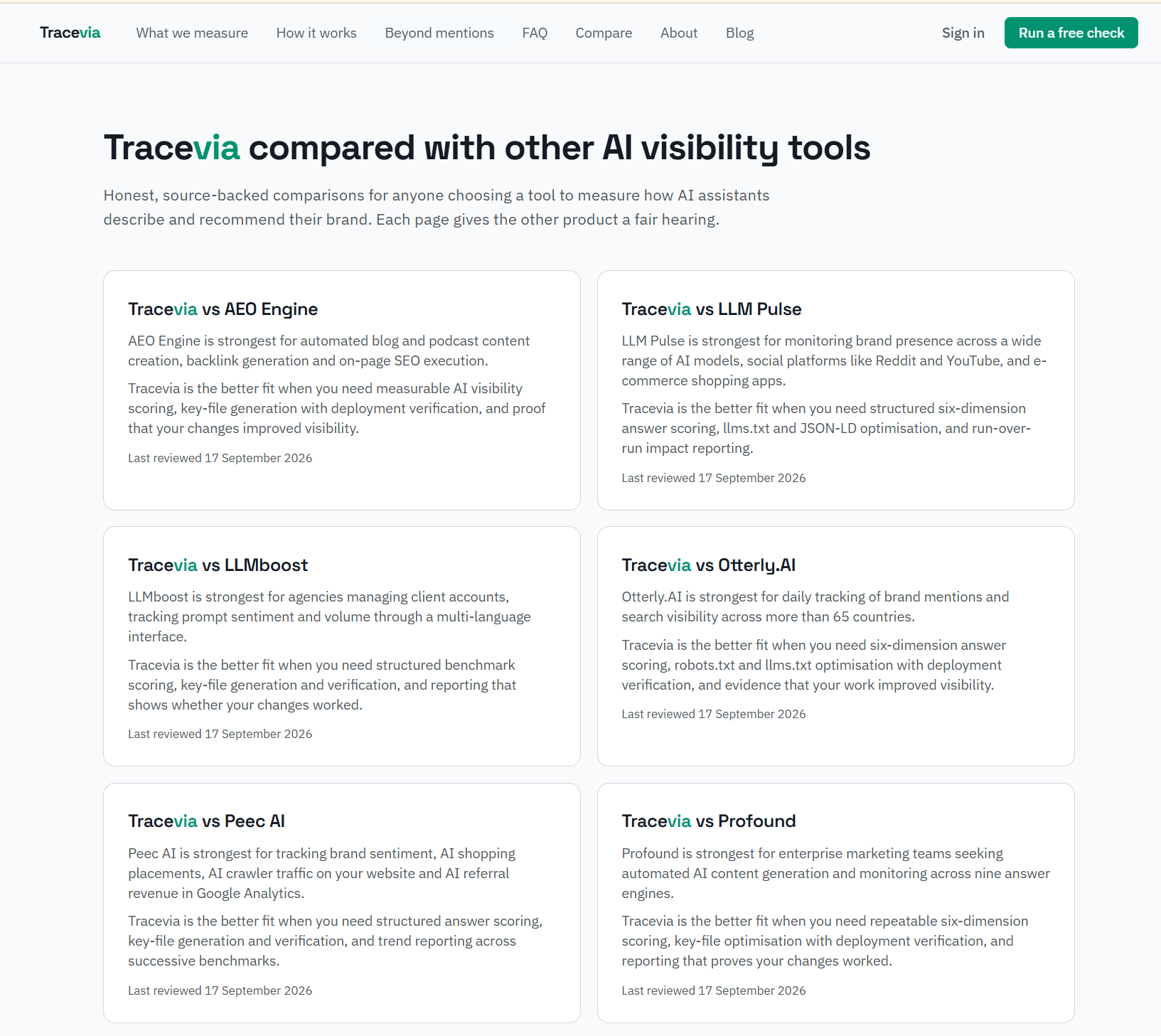
Each comparison looks at areas including:
the fundamental approach taken by each platform;
the AI assistants and search experiences covered;
how AI visibility is measured or scored;
what the platform helps you change or improve;
reporting and historical analysis;
support for different organisational requirements;
areas where Tracevia differs; and
areas where the alternative platform may offer stronger capabilities.
This last point is important.
A useful comparison should help someone choose the right product, not simply tell them that the company publishing the comparison is always the winner.
Compare Tracevia with leading AI visibility platforms
The comparison library currently includes individual comparisons with platforms including AEO Engine, LLM Pulse, LLMboost, Otterly.AI, Peec AI, Profound and Scrunch.
The differences can be significant.
For example, one platform may offer extensive international daily tracking, while another provides AI referral analytics. Another may focus on enterprise content generation, while another combines AI visibility with wider SEO automation.
Tracevia's approach centres on something slightly different:
Measure → Understand → Improve → Measure again

We want organisations to be able to establish how they are currently represented by AI assistants, understand the reasons behind those results, identify practical improvements and then benchmark again to see whether the work had an effect.
That means the question isn't simply:
"Does this tool monitor ChatGPT?"
Increasingly, the better questions are:
"What does the platform measure, how does it measure it, what does it help me do with the results, and can I demonstrate that the changes I make are actually working?"
Look beyond the feature checklist
Feature matrices are useful, but they can also hide important differences.
Two platforms may both say they support "AI visibility monitoring", for example, while providing substantially different information.
One may primarily measure whether a brand was mentioned.
Another may also evaluate where it appeared within the response, how prominently it was presented, whether the organisation was positioned correctly, which sources were cited and whether the answer contained factual inaccuracies.
Similarly, two platforms may both provide "recommendations".
But there is a difference between highlighting an opportunity, generating a technical change, verifying that the change was deployed correctly and subsequently measuring whether visibility changed.
Understanding these differences is more useful than simply counting ticks in a feature table.
Start with your requirements
Before choosing an AI visibility platform, we recommend defining what you actually want to achieve.
Are you primarily trying to track mentions?
Do you need competitive share-of-voice reporting?
Are international or country-specific results important?
Do you need sentiment analysis?
Do you want to understand which third-party sources influence AI answers?
Are you trying to improve the technical information AI systems can discover about your organisation?
Do you need to demonstrate that optimisation work resulted in measurable improvement?
Do you manage multiple websites or brands?
Do you need AI referral traffic and revenue analytics?
Different answers can point towards different platforms. This is precisely why comparisons matter.
Comparisons should evolve with the market
AI visibility is changing rapidly. So are the products designed to measure it.
Features are being introduced, AI engines are changing, new search experiences are appearing and vendors are expanding into adjacent areas such as content generation, analytics, crawler monitoring and AI shopping.
For that reason, the Tracevia comparison pages are based on publicly available product information and include a last reviewed date.
They are intended to evolve as the market evolves.
We also explicitly identify the comparisons as independent editorial comparisons. Tracevia is not affiliated with or endorsed by the companies being compared, and product capabilities, availability and pricing can change. Buyers should always verify critical requirements directly with the relevant vendor before making a purchasing decision.
Find the AI visibility platform that fits your requirement
The emergence of different approaches is a sign that AI visibility is becoming a software category in its own right. That makes informed comparison increasingly important.
The objective of the Tracevia comparison library isn't to suggest that every organisation needs exactly the same AI visibility platform. It is to make the differences clearer.
Because the important question isn't simply:
"Which AI visibility tool has the longest feature list?"
It is:
"Which AI visibility platform best matches what we are actually trying to achieve?"
Explore the new Tracevia Comparison Pages to see how the different approaches compare and decide which capabilities matter most to your organisation.


