

AI Discovery vs AI Visibility vs AI Citations: What’s the Difference?
AI Discovery, AI Visibility and AI Citations: What’s the Difference?
AI Discovery vs AI Visibility vs AI Citations: What’s the Difference?
As people increasingly use AI assistants to research companies, products and services, a new set of terms has entered the marketing vocabulary: AI Discovery, AI Visibility and AI Citations.
They are often used interchangeably, but they describe different things.
A business can be discoverable by an AI system without being particularly visible in its answers. It can be visible without being cited. And it can occasionally receive citations without being consistently recommended.
Understanding these differences is important because each tells you something different about how AI systems understand and represent your business.
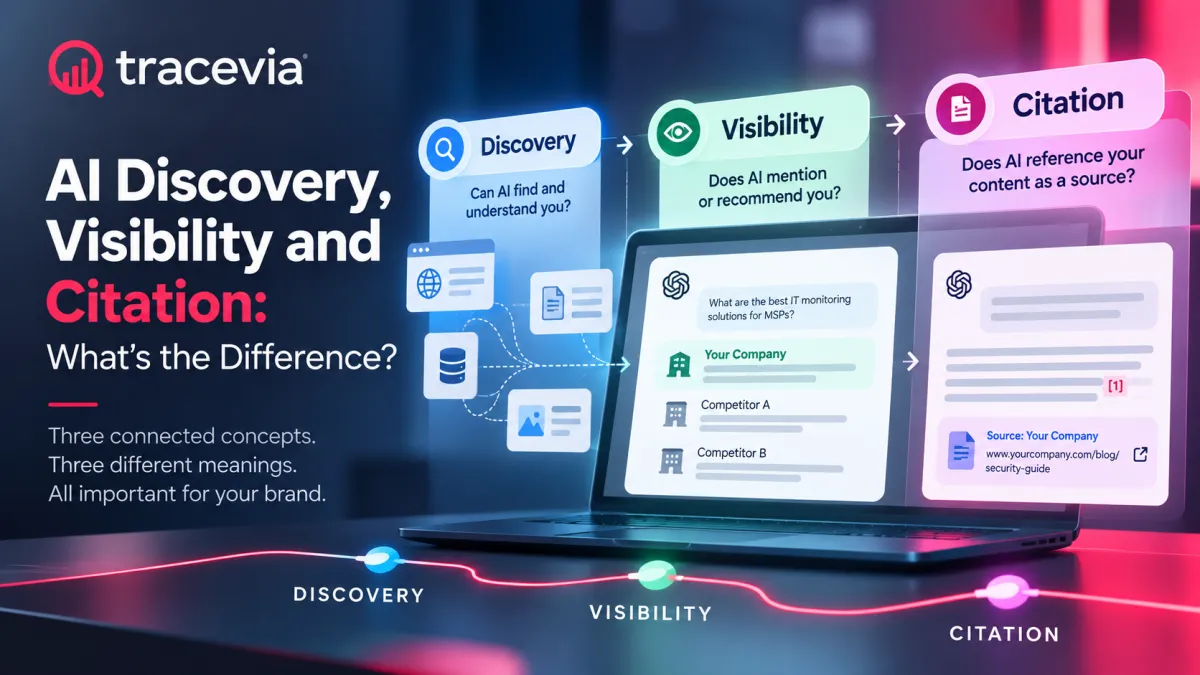
A simple way to think about them is:
Discovery → Can AI find and understand you?
Visibility → Does AI mention or recommend you?
Citation → Does AI reference your content as a source?
They are related, but they are not the same.
1. What is AI Discovery?
AI Discovery is about whether an AI system can find, identify and understand your organisation, brand, products, services and content.
Before an AI assistant can confidently mention a company, it needs information from which it can understand what that company is and what it does.
That information may come from the company's own website, search indexes, structured data, directories, documentation, news coverage, industry websites and many other publicly accessible sources.
Discovery therefore starts with a fundamental question:
Does the AI ecosystem know that you exist and understand what you do?
Imagine a company that manufactures specialist industrial sensors.
Its website may clearly explain its products to a human visitor. However if information about the company is difficult for search engines and AI systems to interpret, inconsistent across the web, or ambiguous, an AI assistant may struggle to associate the company with the relevant product category.
The company exists online, but its AI discoverability is weak.
Why does AI Discovery matter?
Discovery is the foundation for everything that follows.
If AI systems cannot confidently identify your company or understand what you offer, it becomes much harder for them to include you when somebody asks:
"Which companies provide industrial monitoring sensors?"
"What software can monitor Microsoft 365 environments?"
"Which firms provide cybersecurity services for small businesses?"
Discovery isn't about whether you rank first. It is about whether AI systems have enough information to recognise that your organisation is relevant to the subject being discussed.
2. What is AI Visibility?
Discovery asks whether AI can find and understand you.
AI Visibility asks whether you actually appear in AI-generated answers.
This is an important distinction.
An AI system may know that your company exists but still choose not to mention it.
For example, imagine someone asks an AI assistant:
"What are some accounting platforms suitable for small construction companies?"
There may be dozens of relevant products that the AI system knows about. It might mention only five.
Those five companies have gained AI visibility for that particular question.
Visibility therefore isn't simply about being present somewhere within an AI system's knowledge ecosystem. It is about appearing when users ask questions relevant to your business.
AI Visibility is contextual
There isn't really one universal measure of AI visibility.
A company might have excellent visibility for:
"Best accounting software for construction companies"
but poor visibility for:
"Accounting software that integrates with construction project management systems."
It might also appear frequently in one AI assistant but rarely in another.
Visibility therefore needs to be considered across topics, questions, audiences and AI platforms.
This makes AI visibility closer to share of voice than traditional search ranking.
Instead of asking:
"Where do we rank?"
the more useful question becomes:
"When people ask AI systems questions relevant to our business, how often are we part of the answer?"
Why does AI Visibility matter?
Because, increasingly, the AI-generated answer may be the user's research environment.
If someone asks an AI assistant to identify possible products, suppliers or approaches and your competitors are repeatedly mentioned while your organisation is absent, those competitors are gaining exposure before the potential customer ever reaches a traditional search results page.
Discovery gets you into the ecosystem.
Visibility gets you into the conversation.
3. What is an AI Citation?
Citation is different again.
An AI citation occurs when an AI-generated response references a particular webpage, document or source as supporting information for its answer.
Depending on the platform, citations might appear as numbered references, source cards, clickable links or links embedded directly within the answer.
This means an organisation can potentially appear in two different ways.
The AI might mention the company:
"Companies providing this type of technology include Company A, Company B and Company C."
Or it might use the company's content as a source for explaining the subject.
These are not necessarily the same thing.
You can be visible without being cited
Suppose someone asks:
"Who are the major manufacturers of electric vehicles?"
An AI assistant might mention several well-known manufacturers without providing a citation for each company's website.
Those companies have visibility, but not necessarily citations.
You can also be cited without being the recommendation
Consider a different question:
"How does battery degradation affect electric vehicle range?"
An AI system might reference a technical article published by an automotive manufacturer.
That company has gained a citation because its content helped support the answer.
But the AI wasn't necessarily recommending that company's vehicles.
This distinction matters enormously when measuring AI presence.
Why do AI Citations matter?
Citations can provide several benefits.
They can demonstrate that your content is being treated as a useful information source. They can potentially drive referral traffic when users follow the source. They can reinforce authority around a particular subject.
Citations should not be confused with the entire concept of AI visibility.
A company could receive hundreds of citations to informational content while rarely being recommended when potential customers ask which product they should consider.
Conversely, a well-established brand might frequently appear in AI recommendations without receiving a link every time it is mentioned.
Citation is therefore one signal of AI presence—not the whole picture.
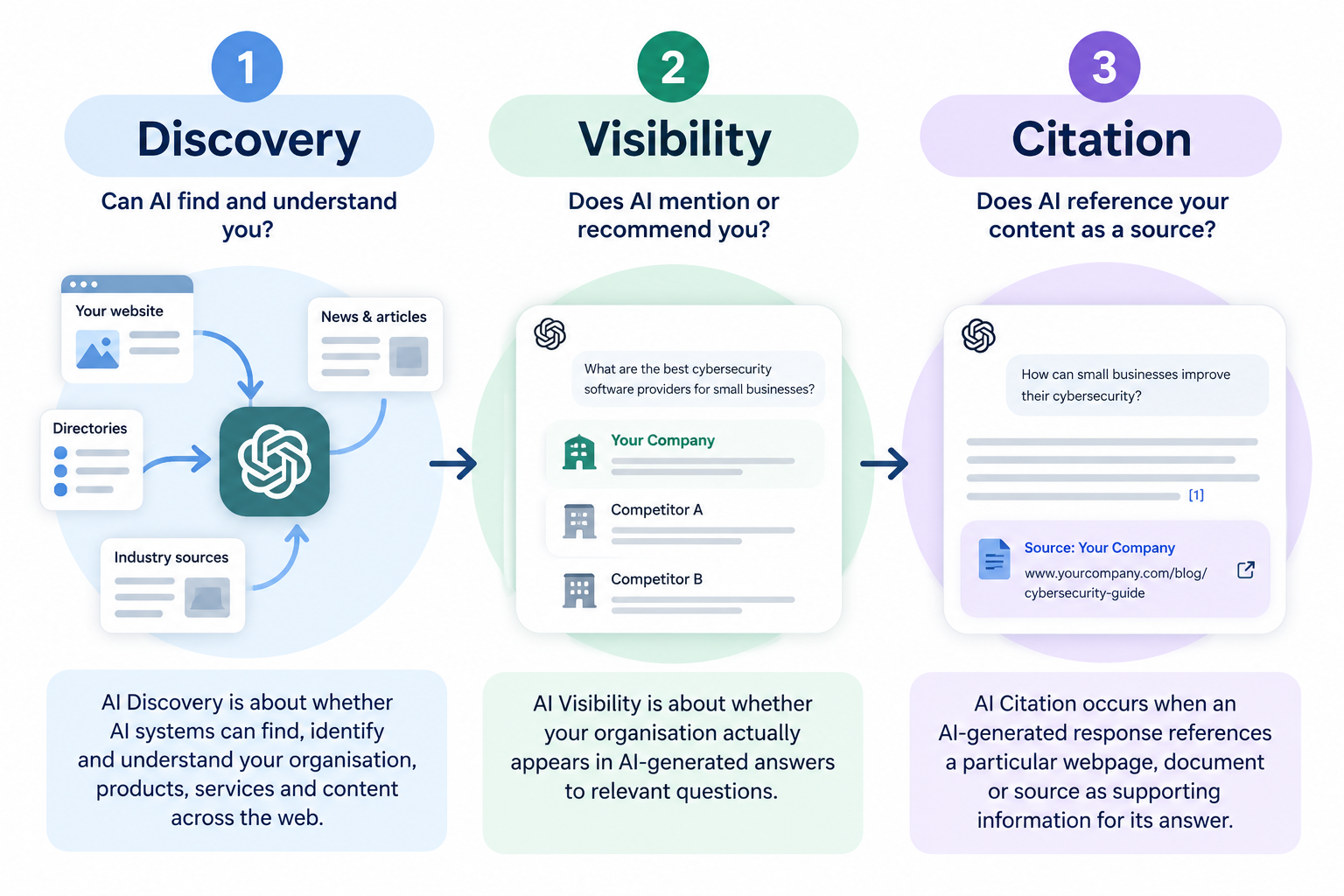
Discovery vs Visibility vs Citation
The easiest way to understand the relationship is to imagine three questions.
Area | The question it answers | Example |
|---|---|---|
AI Discovery | Can AI find and understand us? | The AI understands that your company provides cybersecurity software. |
AI Visibility | Does AI include us in relevant answers? | Your company appears when someone asks for cybersecurity software recommendations. |
AI Citation | Does AI use our content as a source? | The AI links to one of your security research articles when answering a question. |
All three matter, but for different reasons.
They Are Not a Simple Funnel
It can be tempting to think that the process always works like this:
Discovery → Visibility → Citation
Reality is more complicated.
An organisation can be highly discoverable but rarely visible.
A famous brand can be highly visible without receiving many citations.
A publisher, university or research organisation can receive enormous numbers of citations while rarely being recommended as a commercial solution.
The three measurements therefore describe different dimensions of AI presence.
That is why simply counting citations—or simply checking whether an AI assistant knows your company name—doesn't provide a complete picture.
The Question Businesses Should Really Be Asking
Instead of asking:
"Does ChatGPT know about our company?"
a more useful set of questions is:
Can AI systems correctly discover and understand who we are?
Do we appear when people ask questions relevant to our products, services or expertise?
Is our content being referenced as a useful source of information?
And perhaps most importantly:
How does that compare with the organisations we compete with?
These questions move the discussion away from simply being "present in AI" and towards understanding how your organisation participates in AI-generated answers.
Why This Matters Now
Traditional search visibility has historically focused heavily on rankings.
If someone searched Google for a particular phrase, businesses could measure where their pages appeared.
AI-generated answers change that model.
There may be no simple position 1, 2 or 3.
An AI assistant might mention five companies, recommend two, cite three different websites and use information gathered from numerous other sources to construct its response.
That means businesses increasingly need to understand several different dimensions of their AI presence rather than relying on a single ranking metric.
Discovery tells you whether AI understands you.
Visibility tells you whether AI talks about you.
Citation tells you whether AI references you.
Together, they provide a much clearer picture of how a brand exists within an increasingly AI-driven information environment.
Frequently Asked Questions

