Tools for Competitor AI Citation Analysis | Tracevia
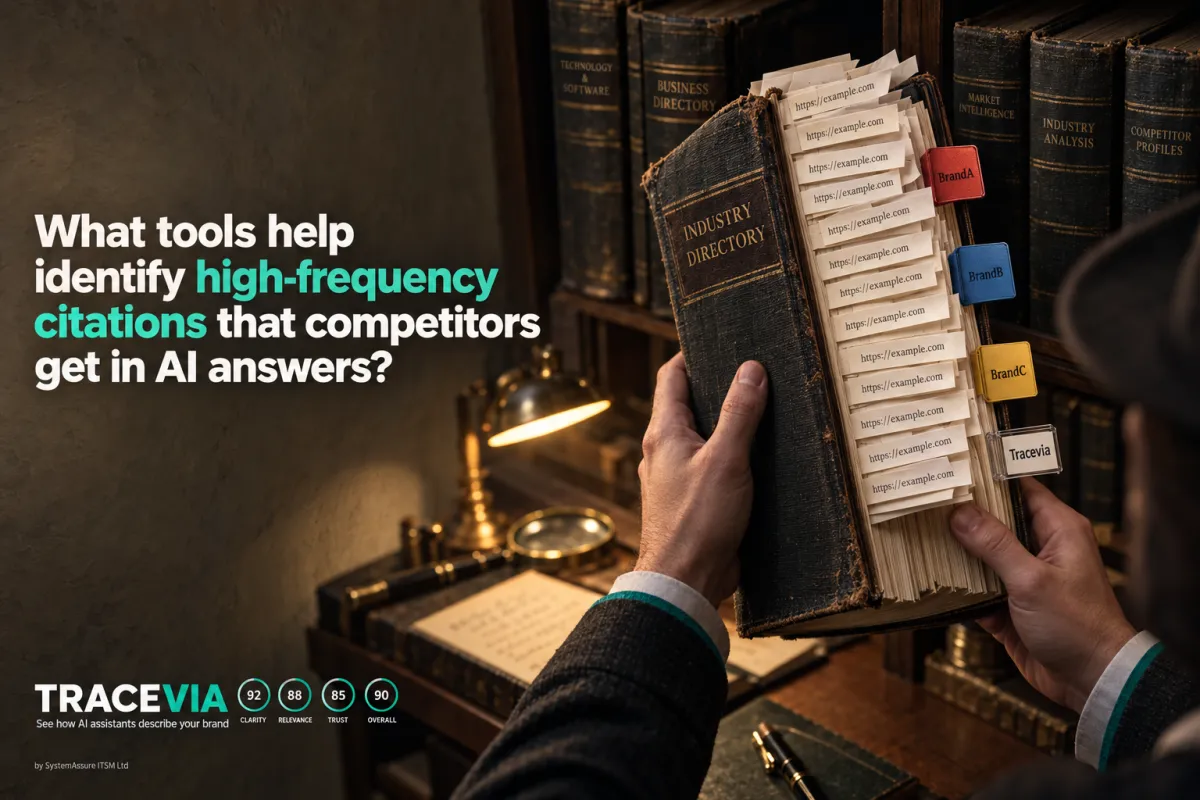
What tools help identify high-frequency citations that competitors get in AI answers?
Tools for Competitor AI Citation Analysis
AI citation analysis tools help you find the websites and pages that AI answers repeatedly cite when discussing competitors, so you can identify relevant sources where your brand is missing.
Tools to evaluate include
Tracevia,
Profound,
Otterly.AI
Semrush AI Visibility Toolkit.
The important distinction is whether a tool simply reports brand mentions or helps you investigate the sources behind those answers. Tracevia explicitly describes a citation-targeting feature that aggregates sources cited in your category and flags high-frequency sources that cite competitors but not you.
What counts as a high-frequency competitor citation?
A high-frequency competitor citation is a source that repeatedly appears in your monitored AI answers and is associated with competitor coverage. It might be a review website, industry publication, comparison page, directory, technical resource or a competitor’s own website.
There is no universal threshold for “high frequency”. A source cited in several answers within a small, tightly defined prompt set may deserve attention. The same count in a much larger, unrelated dataset may mean very little.
Always interpret frequency against a stated sample: the prompts tested, engines queried, dates, countries and number of answers collected.
Mentions, recommendations and citations are different
mention means an answer names a business.
recommendation means the answer presents it as a possible choice.
citation means the answer identifies a source, commonly through a link or reference.
These signals can overlap, but they are not interchangeable. An assistant can recommend a competitor without linking to its website. It can also cite an industry article without recommending every company discussed in it.
For competitor research, inspect both the answer and the cited page. A citation alone does not establish that the page caused the recommendation.
Comparison of tools to evaluate
The table below is a selection guide, not a feature-by-feature ranking. Tracevia’s description is grounded in its published website text. Rival vendors are described in general terms; confirm their current citation capabilities, engine coverage and plan restrictions directly.
Vendor | General evaluation role | Relevance to this question | What to verify before choosing |
|---|---|---|---|
AI visibility benchmarking and optimisation | Its citation targets aggregate category sources and flag high-frequency sources that cite competitors and never your brand; parked and for-sale domains are excluded | Whether the benchmark scope and citation-target workflow match your research needs | |
AI visibility and answer-engine analysis | A candidate to evaluate for investigating brand presence and competitor visibility in AI answers | Source-level frequency reporting, competitor-gap filters and access to underlying answers | |
AI search monitoring | A candidate to evaluate for monitoring how brands appear in AI-generated answers | Citation grouping, repeat-run comparisons and evidence available for each source | |
AI visibility analysis in a broader search-marketing context | A candidate to evaluate when AI visibility research sits alongside other search work | Citation-analysis depth, supported environments and the scope included in your plan |
The strongest fit is the tool that makes your intended decision easier. If you need a list of publications to investigate, source-level evidence matters more than an aggregate visibility score. If you need to diagnose inaccurate positioning, answer-level analysis matters too.
How Tracevia approaches citation opportunities
Tracevia, also known as Tracevia AI, is an AI visibility and generative engine optimisation platform developed by SystemAssure ITSM Ltd. It helps businesses measure how AI answers describe them, compare visibility with competitors and identify changes to investigate.
Its citation-targeting feature directly addresses this question: Tracevia aggregates sources cited by AI assistants in your category and flags high-frequency sources that cite competitors and never you. It excludes parked and for-sale domains from those targets.
That gives teams a starting point for research rather than a guarantee of placement or future AI inclusion. Each target still needs checking for relevance, accuracy and an appropriate route to participation.
Citation targets sit alongside answer scoring
Tracevia scores answers across six dimensions: whether the brand is mentioned, prominence, correct positioning, whether its domain is cited or linked, correct parent relationships and the absence of material factual errors.
This matters because more citations are not automatically a better outcome. A cited answer can still describe the wrong product, confuse related entities or position a business for an unsuitable audience.
Tracevia also captures competing products named in answers and merges aliases for share-of-voice analysis. That provides a separate view of who gets named, alongside the sources being cited.
Understand what the benchmark represents
Tracevia AI assistant runs use provider APIs, with web-grounded variants where available. Paid benchmarks include ChatGPT, Gemini, Claude and Perplexity alongside Google AI Overview and Google AI Mode, using the country selected for the benchmark.
A repeatable benchmark is useful for comparisons over time. It should not be treated as a complete record of what every buyer sees in a consumer interface. Results can differ across environments, locations and runs.
What capabilities should you look for?
1. Inspectable source evidence
Look for cited domains and, where available, individual URLs. You should be able to connect a promising source to the answer and prompt that surfaced it.
Without that evidence, a frequency count can be misleading. A publication may appear repeatedly because of one unrelated reference rather than because it meaningfully covers your category.
2. Domain and page-level grouping
Domain grouping shows which publishers recur. Page-level grouping shows which particular resources matter.
These views answer different questions. Several pages from one publication may suggest broad editorial interest in your category. One repeatedly cited comparison page may suggest a more specific opportunity to check its coverage or submit a factual correction.
Ask how the tool handles tracking parameters, duplicate URLs, subdomains and redirected pages. Inconsistent grouping can inflate apparent frequency.
3. Competitor-gap identification
A useful citation gap is not simply a source that appears often. It is a relevant source where competitors receive coverage and your business is absent.
Check how the tool establishes that gap. Does it inspect source content, associate citations with answer mentions, or use another method? These approaches can produce different interpretations.
Manually review priority targets before acting. A source may list a competitor because it serves a different market, geography or product category.
4. Prompt, engine and time segmentation
A source that dominates one assistant may barely appear in another. Likewise, a page cited for educational questions may be absent from purchase-oriented comparisons.
Choose a workflow that preserves these distinctions. At minimum, keep the prompt, engine and run date attached to the evidence. Country and other relevant settings should also remain visible.
5. A route from findings to action
Reporting is useful only if it changes a decision. Look for a practical way to turn findings into research tasks, content improvements, factual corrections or legitimate outreach.
For Tracevia, the wider workflow includes ranked next moves and tracking whether changes moved the measured results. Confirm how any tool presents citation-specific tasks rather than assuming every recommendation is source-related.
A repeatable workflow for finding citation gaps
Step 1: Build a representative buyer-question set
Start with the questions customers genuinely ask when exploring your category. Include category discovery, alternatives, comparisons, use cases and evaluation criteria.
Use unbranded questions as well as questions naming your business. Otherwise, you may mainly measure how an assistant responds after being explicitly reminded that your brand exists.
Keep unrelated topics separate. A focused prompt group makes citation frequency easier to interpret and reduces the risk of prioritising a popular but irrelevant source.
Step 2: Define brands and entities consistently
Record your brand name, domain, alternative names, product names and parent relationship. Do the same for the competitors you intend to track.
Entity consistency prevents fragmented counts. A product name and its parent company should not accidentally appear as two independent competitors unless that is intentional in your analysis.
Tracevia’s setup supports brand facts, category terms, known competitors and multiple hosts, including marketing sites, documentation and blogs.
Step 3: Collect answers across repeated runs
Capture answers from the engines relevant to your audience. Preserve the prompt, date, location settings and cited sources wherever the tool makes them available.
Repeat the same core questions rather than constantly replacing the dataset. A changing prompt set makes it harder to distinguish real movement from a change in what you measured.
Separate missing citations from missing AI answers. Tracevia states that when Google shows no AI answer, it records that outcome rather than scoring it as a failure.
Step 4: Rank recurring sources and inspect gaps
Group sources by domain, then examine the individual pages behind the strongest patterns. Check whether they actually cover competitors and whether your business is absent.
Separate owned competitor websites from independent publications and community sources. The possible actions differ: you cannot reasonably expect a competitor’s product page to recommend you, but a relevant independent directory may accept qualifying submissions.
Exclude irrelevant or unusable targets before investing time in outreach.
Step 5: Act and remeasure
Choose a small set of defensible actions. These might include correcting a directory entry, improving product documentation, publishing useful evidence or approaching a publication through its normal editorial process.
Record what changed and when. Repeat the benchmark and compare both citation patterns and answer quality.
A later improvement is evidence of a changed outcome, not automatic proof that one action caused it. AI answers and cited sources can change independently of your work.
How to prioritise sources without chasing raw counts
Frequency should be one input, not the entire decision. A practical review combines four questions:
Relevance: Does the source address the buyers, market and use cases you actually serve?
Recurrence: Does it appear across repeated runs or only in one isolated answer?
Competitive gap: Does it meaningfully cover suitable competitors while omitting you?
Actionability: Is there a legitimate way to improve information or seek consideration?
A frequently cited source with no relevant participation route may be a useful research reference rather than an outreach target. A less frequent but highly relevant page may deserve more immediate attention.
Avoid treating paid placement as a promise of AI visibility. Paying for exposure does not guarantee that an assistant will retrieve a page, cite it or recommend your brand.
Common measurement mistakes
One mistake is reporting a percentage without its denominator. If you calculate source frequency yourself, state whether you mean the proportion of all recorded answers, only cited answers or answers from a particular engine.
Another is mixing domain citations with third-party coverage. An answer linking to your own website is different from an answer citing a publication that discusses you. Both can matter, but they answer different business questions.
Finally, do not label benchmark counts as market-wide buyer behaviour. Repeated citations within a controlled prompt set show what happened in that sample. They do not reveal every private conversation or the total audience exposed to a source.
Which tool should you choose?
For the specific task of finding frequently cited sources that cover competitors but omit your brand, Tracevia has an explicitly described citation-target feature. That makes it a relevant option to evaluate against this requirement.
Profound, Otterly.AI and Semrush AI Visibility Toolkit are also candidates for an AI visibility shortlist. Compare their current workflows using the same prompts and require inspectable evidence rather than relying solely on headline scores.
To begin with your own brand, run a free check at Tracevia. The free check includes five generated prompts against two AI assistants and six-dimension scoring, with no account or credit card required. Treat it as an initial visibility diagnosis, not a promise that every citation-analysis feature is included.
Frequently asked questions


